Story shapes and outlines
Start with a story structure or outline you can change as you write.
1. What a shape does
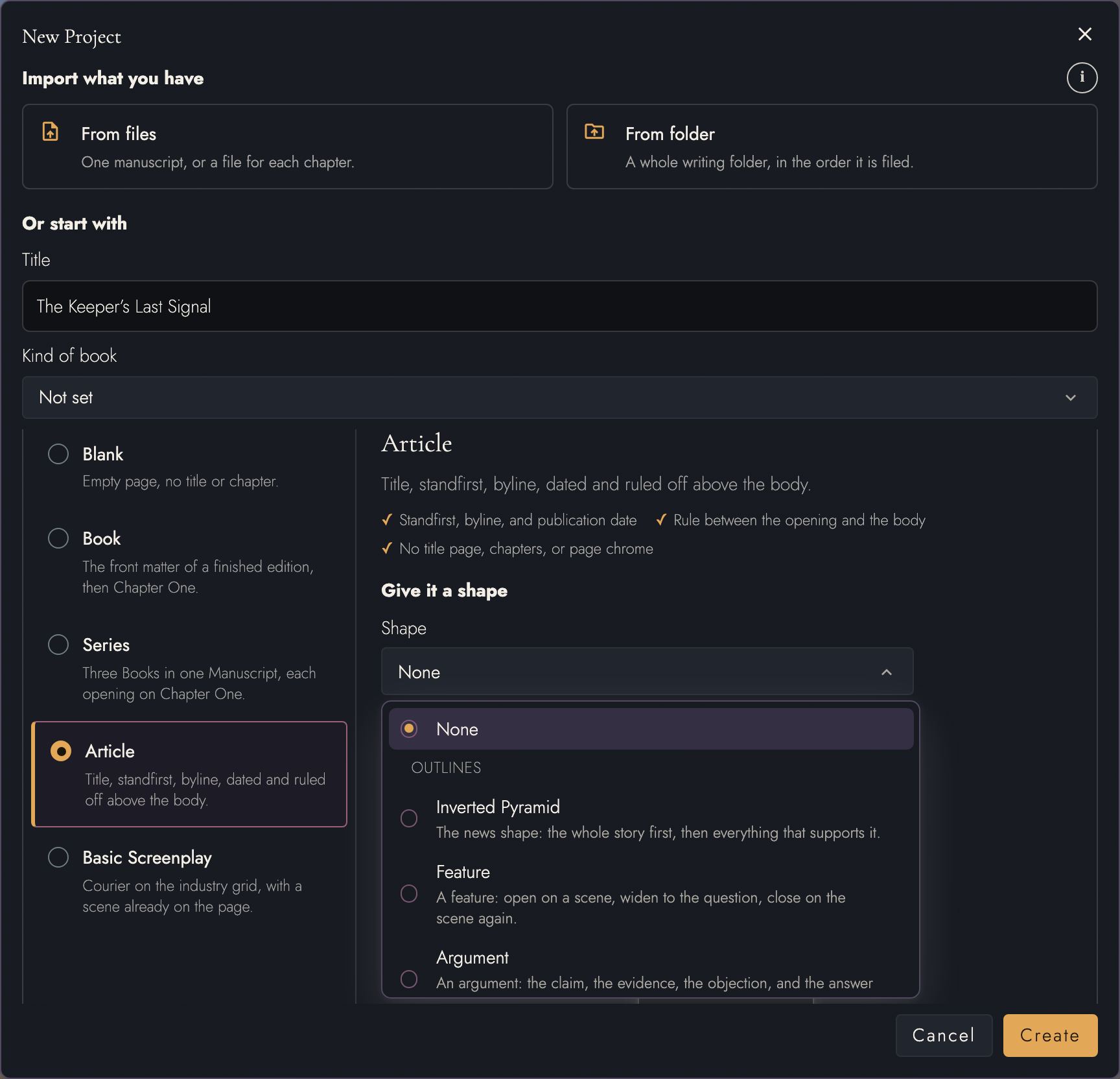
Choose an optional Shape when creating a Project. It supplies a story structure or outline. Everything it creates can be renamed, moved, or deleted later.
A Shape creates starting Acts and Chapters, each with a heading and empty paragraph. Shapes with beats also create Timeline Anchors. It guides structure without deciding your word count or writing sample prose. See anchors.
The starting Outline is part of the Manuscript. As you write or reorder it, you do not need to update a separate planning copy.
2. Three ways to block out a plot
A shape is one way to plan a book before any of it is written. There are two others, and all three put down the same things (Outline rows and anchors in the manuscript), so you can start in one and carry on in another.
- From a shape. Choose a structure in New Project or an available Story structure row. It supplies named sections and any beat Timeline. The rest of this page explains these choices.
- From the Outline. Add sections one at a time using New chapter or a row’s menu. Drag to reorder them or move a Scene between Chapters. The Outline guide explains the controls.
- From the timeline drawer. Use a lane’s plus button to create several structural items or Anchors at once. Timelines explains the lanes.
These methods create the same kinds of Outline rows and Anchors, so you can combine them as your plan develops.
3. Choosing one
Beyond its title and kind of book, the New Project form asks two questions. The starter says what you are making (Book, Series, Article, Basic Screenplay, or Blank), and Shape says how it opens. Only the shapes that suit the starter are listed, and Blank offers none.
You can also add a Shape from these lists in an existing Project:
- Under a Book that holds nothing, in the Outline. It is per Book rather than per project: a Series is three, and two standing empty behind a written first one can each be opened on a structure of their own.
- At the foot of the Timelines list, where the shape brings its own Timeline with it, the one named after it. Dissolving that Timeline afterwards takes the whole structure with it.
- Inside an empty Custom Timeline, which is where the offer began.
Outline offers shapes with structural sections. Timelines offer shapes with beats. Screenplay shapes supply only beats because typed slug lines create their structure.
Adding a structural Shape creates sections in an unwritten Book. In an existing Book, it adds planning Anchors rather than replacing your structure.
Story structures suggest turns while leaving length to you. Outline shapes name a fixed set of sections. Both are planning choices; an outline shape is different from the Outline panel.
Beat-based shapes default to one Chapter per beat. Choose another count and Chapters receive numbers instead of beat names. Outline shapes supply their own named Chapters and fixed count.
In a Series, each Book gets its own Acts and Chapters. The beats form one Timeline spread across the whole Manuscript, from the first Book to the last.
4. The notes on each part
Created Acts, Chapters, and Headings include purpose notes as Anchor comments. Read them in the Outline or Timeline Drawer. Renaming a section keeps its note; you can edit or delete the note.
Beat explanations belong to the named Chapters, not the beat markers. Changing the Chapter count removes that naming and those notes. Beat-only screenplay shapes create titled Timeline markers without section notes.
Scenes carry none. A shape says how many Scenes a Chapter has, but never what each one is for.
5. Shapes for a Book or a Series
Story structures
Each of these seeds Acts and Chapters, and puts its beats on a custom timeline you can dissolve later, taking every beat with it and leaving the prose untouched.
- Three-Act (3 Acts, 5 beats)
-
Setup, confrontation, resolution, and the five turns between them.
Acts
- Act One: Setup: The world, the person, and the thing that goes wrong with both.
- Act Two: Confrontation: The long middle: trying, failing, and learning why it failed.
- Act Three: Resolution: The last attempt, and what the story finally says.
Beats
- Inciting Incident: The thing that happens to them and cannot be undone. The story starts here, not before.
- First Turning Point: They commit. Whatever they could have gone back to is now closed.
- Midpoint: The middle turns: what they wanted is revealed to be the wrong thing, or the cost of it is.
- Second Turning Point: The lowest point, and the decision taken from inside it that makes the ending possible.
- Climax: The confrontation the whole book has been arranging. Nothing is held back.
- Hero's Journey (3 Acts, 12 beats)
-
Departure, initiation and return, in twelve stages.
Acts
- Act One: Departure: Leaving what they know, and everything that makes leaving hard.
- Act Two: Initiation: The unknown world, and what surviving it costs.
- Act Three: Return: Coming back, carrying something the old world needed.
Beats
- Ordinary World: Their life as it stands, so the reader knows what is about to be lost.
- Call to Adventure: The invitation, the summons, or the catastrophe that asks them to leave.
- Refusal of the Call: They say no. Fear, duty, or comfort — the reason is the character.
- Meeting the Mentor: Someone who has been further than they have gives them what they need to start.
- Crossing the Threshold: They go, and the rules change. This is the end of the ordinary world.
- Tests, Allies, Enemies: Learning the new world by being tested in it, and finding out who is who.
- Approach to the Inmost Cave: The approach to the thing they came for, and the dread that comes with it.
- The Ordeal: The worst of it. They face death — their own, or something they love.
- The Reward: They take what they came for. It is rarely what they thought it was.
- The Road Back: Turning for home, pursued by the consequences of having taken it.
- The Resurrection: One last test, at the highest stakes, that proves the change took.
- Return with the Elixir: Home, carrying something that makes the ordinary world different.
- Story Circle (2 Acts, 8 beats)
-
Eight steps down into the unknown and back, changed.
Acts
- Act One: The Descent: Down from the familiar into the unfamiliar, one step at a time.
- Act Two: The Return: Back up, paying for what was taken, arriving changed.
Beats
- In Their Comfort: Where they are at ease. Establish it, because everything after is measured against it.
- They Want Something: A want surfaces. It does not have to be admirable, only real.
- They Cross Into the Unknown: They enter an unfamiliar situation to get it. The rules here are not their rules.
- They Adapt to It: They adapt — learn the new rules, and change a little to fit them.
- They Get What They Wanted: They get the thing they wanted. The story is only half over.
- They Pay the Price: The price arrives. This is the beat the whole shape exists for.
- They Return to the Familiar: Back to where they started, carrying what happened out there.
- They Are Changed: The familiar world reads differently now, because they do.
- Seven-Point (3 Acts, 7 beats)
-
Seven points from the hook to the resolution, built out from the middle.
Acts
- Act One: Setup: The state the story starts in, which is the opposite of how it ends.
- Act Two: Confrontation: Pressure applied twice, with the turn of the middle between.
- Act Three: Resolution: The state the story ends in, earned by everything before it.
Beats
- Hook: The opposite of the ending. Write this last, once you know what you are reversing.
- First Turning Point: The move out of the starting state. Something external forces it.
- First Squeeze: Pressure. Things get worse in a way they cannot answer yet.
- Midpoint: They stop reacting and start acting. The middle of the shape, and its hinge.
- Second Squeeze: Worse pressure. Whatever was helping them is taken away.
- Second Turning Point: They get the last thing they need to finish it — knowledge, ally, or resolve.
- Resolution: The state the hook promised the reverse of. This is the pair that holds the shape together.
- Fifteen-Beat Sheet (3 Acts, 15 beats)
-
Fifteen beats from the opening image to the closing one.
Acts
- Act One: The world as it is, and the thing that ends it.
- Act Two: The new world: the promise of the premise, then the bill for it.
- Act Three: What they do with what they learned.
Beats
- Opening Image: The first picture of the world, before anything has moved. It is there to be answered by the last one.
- Theme Introduced: Someone says what the story is about, usually in passing, and usually without knowing it.
- Setup: The ordinary life, drawn well enough that losing it will cost something.
- Inciting Incident: The thing that happens to them. Not chosen, and not undoable.
- Hesitation: They argue with it — refuse, delay, look for another way out. The last of the old life.
- First Turning Point: They choose to go. The door closes behind them and the story proper begins.
- Second Thread Opens: A second line opens — a relationship, a rival, a subplot — that will carry the theme.
- Rising Complications: The stretch the story was sold on: the new world worked through, before the cost arrives.
- Midpoint: The middle turns. A false victory or a false defeat, and from here the pressure only rises.
- Forces Close In: Everything that opposes them tightens at once, inside and out.
- Lowest Point: They lose the thing that mattered. Often someone dies, or something does.
- The Long Night: The stillness after the loss, where they face what they have been avoiding the whole way.
- Second Turning Point: What they learned in the dark gives them the answer. They go back in, changed.
- Finale: They act on it, and the opposition is beaten for real this time.
- Closing Image: The opening image again, and different. This is the proof that the change was real.
- Three Disasters (3 Acts, 5 beats)
-
Grown outward from one sentence: a premise, three disasters, and the ending they force.
Acts
- Act One: The Premise: One sentence, grown into a world: who this is about, and what they are about to lose.
- Act Two: The Consequences: Two disasters they bring on themselves, each one the price of how they answered the last.
- Act Three: The Ending: What the third disaster left them no way around, and what it cost to go through it.
Beats
- The Premise: The whole book in one sentence, then in a paragraph. Who wants what, and why they cannot have it yet.
- First Disaster: The first thing to go badly wrong. This one may arrive from outside; nothing after it may.
- Second Disaster: Caused by how they answered the first. The middle turns here, and it turns because of them.
- Third Disaster: The worst of the three, and the one that leaves only one way out. Again, their own doing.
- The Ending: The way out they were left, taken. It should need no explaining once it has happened.
- Romance Beat Sheet (4 Acts, 16 beats)
-
The romance arc, from the meet to the ending that earns itself.
Acts
- Act One: Setup: Two people with separate lives, and the reason they will not work.
- Act Two: Falling in Love: Everything pulling them together, against their own better judgment.
- Act Three: Retreating from Love: Everything pulling them apart, and why it is their own doing.
- Act Four: Fighting for Love: Choosing it anyway, having understood the cost.
Beats
- Separate Lives: Each of them alone, and what each is missing without knowing it.
- They Meet: The first time they are in the same room. It should be difficult.
- First Refusal: The reason this cannot happen — stated plainly, and believed by both.
- Thrown Together: Circumstance forces them together and keeps them there.
- First Attraction: The first moment either of them wants it, before either admits it.
- Attraction Deepens: They start choosing each other in small ways.
- This Might Work: A glimpse of the life they could have. Let the reader want it too.
- Midpoint of Love: The high point of the romance, and the last uncomplicated one.
- First Doubt: The first crack — usually the original objection, returning with evidence.
- Doubt Deepens: The crack widens. Old fears do the talking.
- Pulling Away: One of them protects themselves by withdrawing.
- The Break: It ends. Both believe it, and so should the reader.
- The Long Night: Apart, and forced to sit with what they actually want.
- Facing the Truth: The flaw is named and owned. Without this the ending is not earned.
- The Gesture: A public, costly act that proves the change. Risk something real.
- Together: Together, on terms neither could have accepted at the start.
- Cozy Mystery (4 Acts, 11 beats)
-
A small world, a body, the suspects, a wrong answer, and the right one.
Acts
- Act One: The Crime: The small world, the people in it, and the death that breaks its peace.
- Act Two: The Suspects: Everyone with a reason, and the one lie each of them is telling.
- Act Three: The Wrong Answer: A second blow, and a confident answer that turns out to be wrong.
- Act Four: The Solution: The detail that was there all along, the reveal, and the world put right.
Beats
- The Community: The village, shop, or circle the sleuth belongs to. Everyone worth suspecting later appears here doing something ordinary.
- The Body: A death that disturbs the peace, on the page or just off it. Early, and never gratuitous.
- Drawn In: Why an amateur cannot leave it to the police: a friend accused, a debt owed, their own name on the list.
- The Suspects: Each suspect gets a motive, a secret, and a lie about something smaller than the murder.
- The False Lead: The evidence points somewhere convincing. Play it fairly: the reader should believe it too.
- The Second Blow: A second death or an attack that rules out the easy theory and raises the stakes.
- A Warning: The sleuth has come close enough to be a threat, and someone makes that clear.
- The Wrong Answer: They accuse, or nearly accuse, the wrong person, and it costs them a friendship or their standing.
- The Overlooked Detail: Something planted in the first act reads differently now. Only now does the pattern hold.
- The Reveal: The killer named, and every clue shown to fit. The reader should think: I could have seen it.
- Order Restored: The community mended and a little changed, with one thread left loose for the next book.
- Thriller (4 Acts, 12 beats)
-
A threat, a clock, a chase, a twist, and a showdown with seconds left.
Acts
- Act One: The Threat: The danger, the one person able to stop it, and the deadline.
- Act Two: The Chase: Move and countermove, with the opposition always a step ahead.
- Act Three: The Reversal: The truth about the threat changes, and the hero loses everything they were using.
- Act Four: The Showdown: A plan only this hero could make, carried out with the clock nearly out.
Beats
- Cold Open: Show the danger before the hero: a crime, a leak, a body, a clock started. The reader knows more than anyone on the page.
- The Specialist: What the hero is good at, which the plot will test, and what they are bad at, which it will use against them.
- It Becomes Personal: The danger reaches them personally. From here the stakes have a face.
- The Clock: A deadline, stated plainly. Everything after is measured against it.
- First Move: They act on their own terms, and it half works.
- The Countermove: The opposition answers, smarter than expected and already a step ahead.
- The Twist: What they believed about the threat is wrong. The target, the motive, or an ally changes sides.
- Cut Off: Their support is stripped away: suspended, hunted, or simply not believed.
- Everything Lost: The opposition wins a round that matters. Someone is lost, or the clock jumps forward.
- The Last Plan: They use the thing only they know or can do, set up in the first act.
- The Showdown: Face to face, with seconds left. The hero wins by skill and cost, never by luck.
- The Aftermath: The world safe again, and what the hero paid to make it so.
- Epic Fantasy (4 Acts, 12 beats)
-
Many threads scattered across a world and brought back together for the end.
Acts
- Act One: The World Before: Many people in many places, and the sign that their world is ending.
- Act Two: The Scattering: The company formed and broken, each thread sent its own way.
- Act Three: The Reckoning: The true size of the enemy, the price of power, and the worst loss.
- Act Four: The Last Battle: The threads converge, and the war and the personal stakes are settled together.
Beats
- The Old Wound: A short glimpse of the history about to come due. Keep it brief, and pay it off later.
- Many Homes: Each point-of-view character in their own corner of the world, wanting something small.
- The Sign: The omen, invasion, or death that says the old order is ending.
- The Company Forms: The characters are drawn together, often unwillingly, around one purpose.
- The Company Breaks: Betrayal, battle, or choice splits them. From here their threads run apart.
- Separate Trials: Each thread learns something the others will need, in a place the others never see.
- The Enemy Revealed: The threat is bigger than the quest planned for, and the plan no longer fits it.
- The Price of Power: Magic, a crown, or an alliance, gained at a price that will be collected.
- The Fall: The worst loss: a city, a leader, or a character the reader trusted to survive.
- The Threads Converge: The scattered characters meet again, each carrying their piece of the answer.
- The Last Battle: The war and the personal stakes decided in the same place, at the same time.
- The World After: What was saved, what was not, and who is left to rebuild.
- Romantic Suspense (4 Acts, 12 beats)
-
A romance and a threat that rise together and resolve in the same scene.
Acts
- Act One: Danger and a Stranger: A danger already moving, and the stranger it throws them together with.
- Act Two: Forced Trust: Trusting each other because they have to, and then because they want to.
- Act Three: The Betrayal: The evidence turns one of them into a suspect, and the trust breaks.
- Act Four: Love Under Fire: The threat and the relationship settled in the same scene.
Beats
- The Threat Begins: Something dangerous starts in one of their lives before they meet.
- They Meet in It: They meet because of the danger, and each suspects the other a little.
- A Reason to Stay: Protection, a shared investigation, or a secret keeps them close.
- Attraction Under Pressure: Wanting each other at the worst possible time, and knowing it.
- Working Together: They start to trust each other’s judgment, and the case begins to move.
- A Close Call: The danger nearly takes one of them. The fear afterward says what they feel.
- Giving In: They act on it. The emotional high point, with the threat still unsolved.
- The Evidence Turns: Something makes one of them look guilty, or at least untrustworthy.
- Trust Breaks: Trust fails at the moment the threat gets closest.
- Taken: The villain moves: one of them is taken, trapped, or alone with the danger.
- The Rescue: Each saves the other in some way. The romance and the plot resolve together.
- Safe Together: The danger over, and the relationship chosen in daylight.
- Paranormal Romance (4 Acts, 12 beats)
-
A romance across the line between the everyday world and a hidden one.
Acts
- Act One: Two Worlds: One of them in the everyday world, and a glimpse of the other one.
- Act Two: The Secret Shared: What one of them is comes out, and so does the law against them.
- Act Three: The Law Enforced: The other world moves to end it, and their own nature does harm.
- Act Four: Choosing Across Worlds: A sacrifice offered, and a way found through the law rather than around it.
Beats
- An Ordinary Life: One of them lives in the everyday world with no idea what shares it.
- The Other World Intrudes: A glimpse of the supernatural, usually through the other love interest.
- They Meet: The attraction arrives with a warning: something about this person is not right.
- The Secret Kept: The supernatural one hides what they are, for a reason the reader understands.
- The Reveal: What they are is out. The other decides whether to run.
- The Law: The law of the other world that forbids this: a pack, a court, a curse, or a hunger.
- Together Anyway: They choose each other in private, and break the law to do it.
- Found Out: The other world finds out and moves to end it.
- Their Nature Shows: What the supernatural one is does real harm, or nearly does.
- The Sacrifice: One offers to give up their world, their power, or their life.
- A Way Through: The law is broken, changed, or outwitted, and they do it together.
- Between Worlds: Together, in a life that belongs to neither world as it was.
- Pulp Formula (4 Acts, 10 beats)
-
A short story in four equal quarters, each ending on a twist.
Acts
- Part One: Trouble: Before the first line, choose one unusual danger, one unusual prize, one unusual setting, and a menace over the hero. Then straight into trouble, and end the quarter on a twist.
- Part Two: Worse: The hero fights back and it goes worse. End on a second twist.
- Part Three: Headway: Real progress, paid for, and the deepest trap yet.
- Part Four: The Way Out: Out by their own skill, a last surprise, and a fast finish.
Beats
- Open in Trouble: The opening line puts the hero in a fix. No warm-up and no weather.
- Everyone on Stage: Bring on the whole cast in the first quarter, each doing something that matters later.
- First Twist: End the first quarter on a complication that changes the problem.
- Pile It On: The hero pushes back and it goes badly: a fight, a trap, a setback they can feel.
- Second Twist: End the second quarter on a turn that makes everything worse.
- Headway: The hero gets somewhere at last, and it costs them.
- The Deepest Trap: A third twist, and the worst trap yet.
- Their Own Way Out: They get out through their own wit or ability. Never luck, never rescue.
- The Last Surprise: The villain unmasked, or the prize not what it seemed.
- The Last Line: A short turn or a line that lands, and then stop.
- Freytag's Pyramid (5 Acts, 9 beats)
-
Five acts rising to a turn at the peak and falling to the outcome.
Acts
- Act One: Exposition: Who, where, and the tension already present before anything moves.
- Act Two: Rising Action: Each attempt adds a difficulty, and the tension climbs.
- Act Three: Climax: The peak, where the hero’s fortunes turn.
- Act Four: Falling Action: The consequences of the turn, working themselves out.
- Act Five: Resolution: The outcome: ruin in a tragedy, a new order in anything else.
Beats
- The Situation: The people, the place, and the pressure already in it.
- The Spark: The event that sets the conflict moving and cannot be taken back.
- Complication: The first attempt to deal with it, and the new difficulty it causes.
- Stakes Raised: The stakes rise and the options narrow. Turning back is no longer possible.
- The Turn: The top of the pyramid. The hero’s fortunes reverse, for better or worse.
- Consequences: The first consequences of the turn arrive, and the other side answers.
- A Last Hope: A moment where the outcome seems in doubt again, just before it is settled.
- The Outcome: The outcome the whole shape has been falling toward.
- The New Order: The world after, and what it has learned or lost.
- Kishōtenketsu (4 Acts, 8 beats)
-
Four movements, with a twist in place of a conflict.
Acts
- Act One: Introduction: The people and the place, shown as they are. Conflict is not required.
- Act Two: Development: The same situation followed further, until the reader thinks they know it.
- Act Three: Twist: Something unexpected enters that seems to belong to another story.
- Act Four: Reconciliation: The two halves brought together, and the whole seen differently.
Beats
- What Is: Who is here and what their days are like. Let the reader settle.
- A Detail Worth Noticing: One particular thing worth watching: a habit, an object, a relationship.
- Going Deeper: Follow it further. The situation deepens without having to go wrong.
- The Pattern Settles: The reader thinks they know what kind of story this is.
- Something Unexpected: An element that seems unrelated arrives: a new place, a stranger, a change of view.
- Holding the Contrast: Let the new element stand on its own long enough to be strange.
- The Connection: The ending finds how the twist and the first half belong together.
- Seen Anew: The opening read again in the light of the whole.
Outlines
These name their Chapters instead of asking how many, because there the sections are the method. They carry no beats, so they create no timeline.
- Twenty-Seven Chapter (3 Acts, 27 named Chapters, 3 Scenes in each Chapter)
-
Twenty-seven chapters, nine to an act, three scenes in each.
Acts
- Act One: Nine chapters from the ordinary world to the commitment.
- Act Two: Nine chapters in the new world, turning at the midpoint.
- Act Three: Nine chapters from the trials to the resolution.
Chapters
- Introduction: The world and the person, drawn well enough to be missed.
- Inciting Incident: The event that starts it. It happens to them.
- Immediate Reaction: The first thing they do, unthought. Usually wrong.
- Considered Reaction: The second thing, after they have had time to think.
- First Action: They try to fix it their own way.
- Consequence: It does not work, and something is now worse.
- Pressure: The situation tightens. Doing nothing stops being an option.
- First Squeeze: A hard moment that forces the choice.
- Commitment: They step into the new world. Act One ends here.
- The New World: Different rules, and they do not know them yet.
- Learning Its Rules: They find out how this place works by getting it wrong.
- Looking Back: A reminder of the old life, and how far they have come from it.
- Building Up: Small wins. Confidence, earned or false.
- Midpoint: The turn. They stop reacting and start deciding.
- Reversal: What they believed is overturned.
- Reaction: The cost of the reversal lands.
- Second Action: A new plan, made from what they now know.
- Dedication: They commit fully. Act Two ends here.
- Trials: Everything in the way, all at once.
- Second Squeeze: The hardest pressure yet.
- Darkest Moment: They lose. Let it be a real loss.
- Renewed Resolve: They find the thing inside them the story has been building toward.
- Third Action: They move, with nothing held back.
- Converging: Every thread arrives at the same place.
- The Confrontation: The fight, the argument, the reckoning.
- Climax: It is decided.
- Resolution: The world after. Answer the opening.
- Memoir (9 named Chapters)
-
A life told as a narrative, from the opening scene to what it left behind.
Chapters
- Opening Scene: A moment, not a summary. Put the reader in the room.
- Background: Where you came from, only as much as the story needs.
- The Turning Point: The thing that divides the life into before and after.
- Rising Difficulty: What it cost, as it went on costing.
- The Crisis: The worst of it, told plainly.
- The Reckoning: The moment you saw it for what it was.
- What Changed: What you did differently, and what it took.
- Reflection: What you understand now that you could not then.
- Closing Scene: Another moment. Let it answer the first one.
- Biography (10 named Chapters)
-
Another person's life, from where it began to what it left behind.
Chapters
- Opening Scene: The moment that shows who they were. Not the birth.
- Origins and Family: Where they came from and what it gave them.
- Formative Years: What shaped the person before the work did.
- First Work: The beginning of what they are known for.
- The Breakthrough: The turn that made the rest possible.
- Height of Influence: The work at full strength, and its reach.
- Conflicts and Setbacks: The opposition, the failures, the harm.
- Later Years: What came after the height, and how they met it.
- Death and Legacy: The end, and what outlasted it.
- Sources and Notes: Where each claim came from.
- Book Proposal (8 named Chapters)
-
The sections a publisher reads, in the order they read them.
Chapters
- Overview: The book in a paragraph, written to be quoted back to you.
- About the Book: What it is, how long, and why it works as a book.
- About the Author: Why you are the one to write it.
- Market and Audience: Who buys it, and how many of them there are.
- Comparable Titles: Books it sits beside, and what yours does that they do not.
- Marketing and Platform: What you can do to sell it, concretely.
- Chapter Outline: Every chapter, a paragraph each.
- Sample Chapters: The writing itself. This is what decides it.
- Self-Help (10 named Chapters)
-
A problem, an idea, the steps that apply it, and what gets in the way.
Chapters
- The Problem: Name the reader’s problem better than they can.
- Why It Happens: The cause, so the fix is not arbitrary.
- The Core Idea: The one thing this book is actually saying.
- First Step: The smallest action that starts it.
- Second Step: What builds on the first.
- Third Step: What makes it stick.
- Common Obstacles: What goes wrong, and what to do then.
- Putting It Together: The whole thing, worked through once.
- Keeping It Going: How it survives contact with an ordinary week.
- Conclusion: What changes if they do it.
6. Shapes for an Article
An article has no Chapters. It is one continuous piece whose structure is the headings inside it, so these name Headings, under the standfirst and the rule the Article starter seeds. They carry no beats.
- Inverted Pyramid (6 Headings)
-
The news shape: the whole story first, then everything that supports it.
Headings
- What Happened: The whole story in a sentence or two. A reader who stops here still knows it.
- Why It Matters: The reason this is news now, and to whom.
- The Detail: The specifics: numbers, names, sequence.
- Background: What a reader needs to know to make sense of it.
- What People Say: Quotes and reaction, from the people it lands on.
- What Happens Next: What is still unresolved, and when it will be.
- Feature (7 Headings)
-
A feature: open on a scene, widen to the question, close on the scene again.
Headings
- Opening Scene: One person, one moment, told closely. No thesis yet.
- The Question: Pull back and say what the piece is really about.
- How It Came About: The history that produced the situation.
- The Turn: The complication, the surprise, or the counter-example.
- What Complicates It: The part that resists the easy reading.
- Where It Stands: The situation now, honestly, including what is unknown.
- Closing Scene: Back to the person from the opening, and what changed.
- Argument (7 Headings)
-
An argument: the claim, the evidence, the objection, and the answer to it.
Headings
- Introduction: The question, and why it is worth settling.
- The Claim: What you are arguing, stated so plainly it could be disagreed with.
- The Evidence: The reasons to believe it, strongest first.
- The Objection: The best case against you, made fairly.
- The Answer: Why the objection does not defeat the claim.
- What Follows: What changes if you are right.
- Conclusion: The claim again, now earned.
- Review (6 Headings)
-
A review: what it is, what it does well, what it does not, and the verdict.
Headings
- What It Is: The thing itself: what it is, who made it, what it costs.
- First Impressions: What using it is like before you have an opinion.
- What Works: The strongest case for it, with specifics.
- What Does Not: The failures, with the same specificity.
- How It Compares: The alternative a reader is probably weighing it against.
- Verdict: Who should get it, and who should not.
7. Shapes for a Screenplay
A script's structure is the slug lines you type, and the Outline turns each one into a Scene by itself, so these seed no Scenes and no Chapters. What they contribute is the beat sheet: named anchors spread across the script in proportion, to drag onto the scenes as you write them.
- Feature: Three-Act (7 beats)
-
The feature shape: two act breaks, a midpoint, and the images that frame it.
Beats
- Opening Image: The first thing on screen. It should be answered by the last.
- Inciting Incident: The event that starts it, roughly ten to fifteen pages in.
- End of Act One: They commit, and the story moves into its real setting.
- Midpoint: The turn: a false win or a false loss, and the pressure rises after it.
- End of Act Two: The lowest point, and the decision made from inside it.
- Climax: The confrontation the film has been arranging.
- Closing Image: The last thing on screen. Rhyme it with the first.
- Feature: Fifteen-Beat (15 beats)
-
Fifteen beats across a feature, from the opening image to the closing one.
Beats
- Opening Image: The first picture of the world, before anything has moved. It is there to be answered by the last one.
- Theme Introduced: Someone says what the story is about, usually in passing, and usually without knowing it.
- Setup: The ordinary life, drawn well enough that losing it will cost something.
- Inciting Incident: The thing that happens to them. Not chosen, and not undoable.
- Hesitation: They argue with it — refuse, delay, look for another way out. The last of the old life.
- First Turning Point: They choose to go. The door closes behind them and the story proper begins.
- Second Thread Opens: A second line opens — a relationship, a rival, a subplot — that will carry the theme.
- Rising Complications: The stretch the story was sold on: the new world worked through, before the cost arrives.
- Midpoint: The middle turns. A false victory or a false defeat, and from here the pressure only rises.
- Forces Close In: Everything that opposes them tightens at once, inside and out.
- Lowest Point: They lose the thing that mattered. Often someone dies, or something does.
- The Long Night: The stillness after the loss, where they face what they have been avoiding the whole way.
- Second Turning Point: What they learned in the dark gives them the answer. They go back in, changed.
- Finale: They act on it, and the opposition is beaten for real this time.
- Closing Image: The opening image again, and different. This is the proof that the change was real.
- Feature: Hero's Journey (12 beats)
-
Departure, initiation and return, timed to a feature.
Beats
- Ordinary World: Their life as it stands, before anything asks them to leave it.
- Call to Adventure: The summons. On screen this arrives early.
- Refusal of the Call: They say no, and the reason tells us who they are.
- Meeting the Mentor: Someone gives them what they need to begin.
- Crossing the Threshold: They go. The rules change here.
- Tests, Allies, Enemies: The new world learned by being tested in it.
- Approach to the Inmost Cave: Closing on the thing they came for.
- The Ordeal: The worst of it, and a death of some kind.
- The Reward: They take it. It is rarely what they expected.
- The Road Back: Turning home, pursued by what they did.
- The Resurrection: The last test, at the highest stakes.
- Return with the Elixir: Home, carrying something the old world needed.
- Television: Act-Outs (6 beats)
-
An hour of television: a teaser, four act-outs, and a tag.
Beats
- Teaser: The cold open. Ask a question worth staying through the titles for.
- End of Act One: A turn hard enough to hold an audience across the break.
- End of Act Two: Raise it. Something they believed is wrong.
- End of Act Three: The worst moment. The break should hurt.
- End of Act Four: The resolution of the episode’s question.
- Tag: The short scene after: a landing, or a hook for next week.
8. Adding a shape later
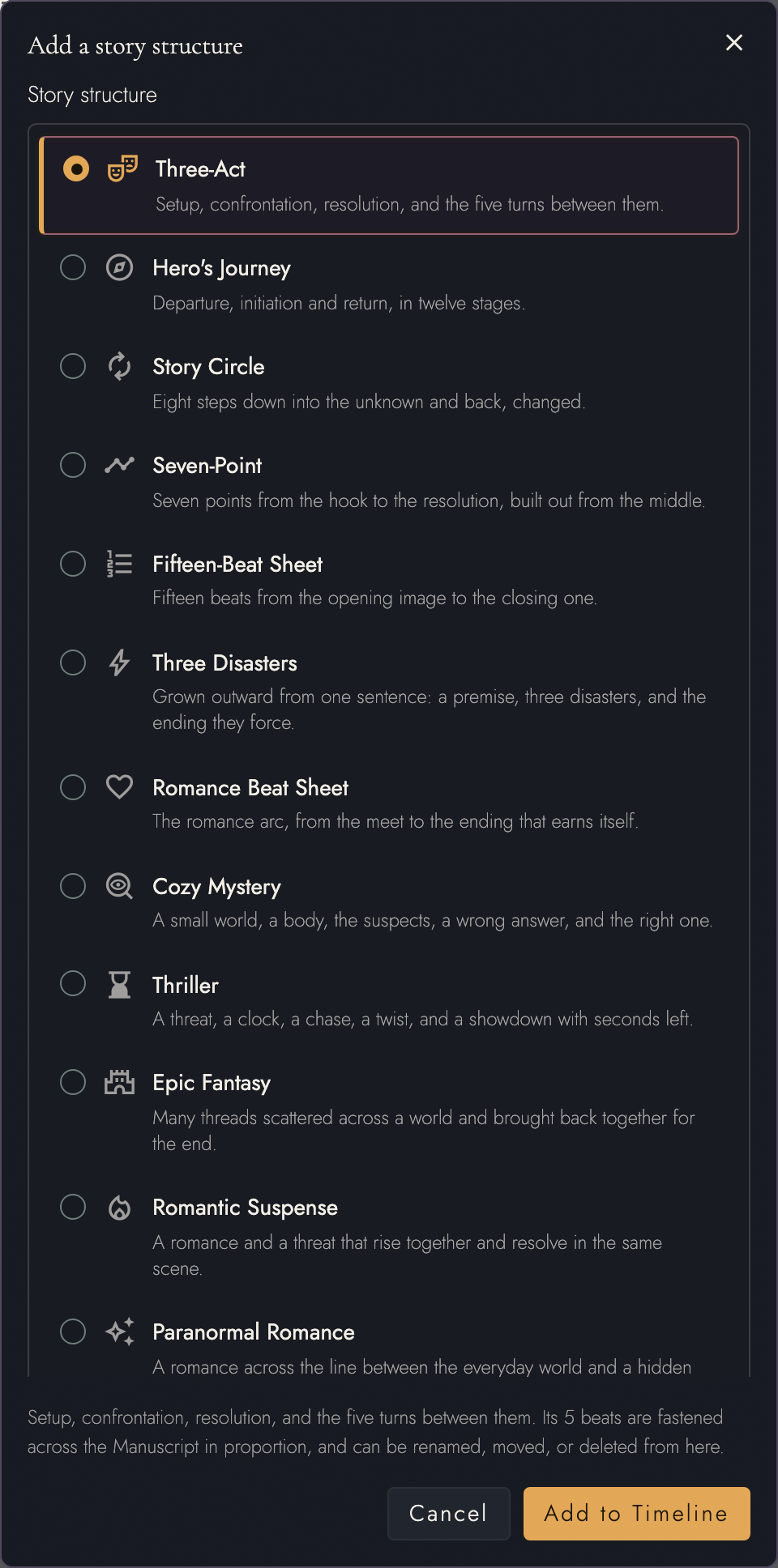
To add beats to existing writing, create an empty Custom Timeline and press Story structure. Choose a beat-based shape. Its Anchors are spread across the current Working Scope by share of its words, so a run of short dialogue lines does not pull the beats toward it, and no Chapters are added. See working scope .
Story structure, the last row of the Timelines list, just below New timeline, skips the empty Timeline: one arrives with the beats, named after the shape.
9. Using a downloaded template
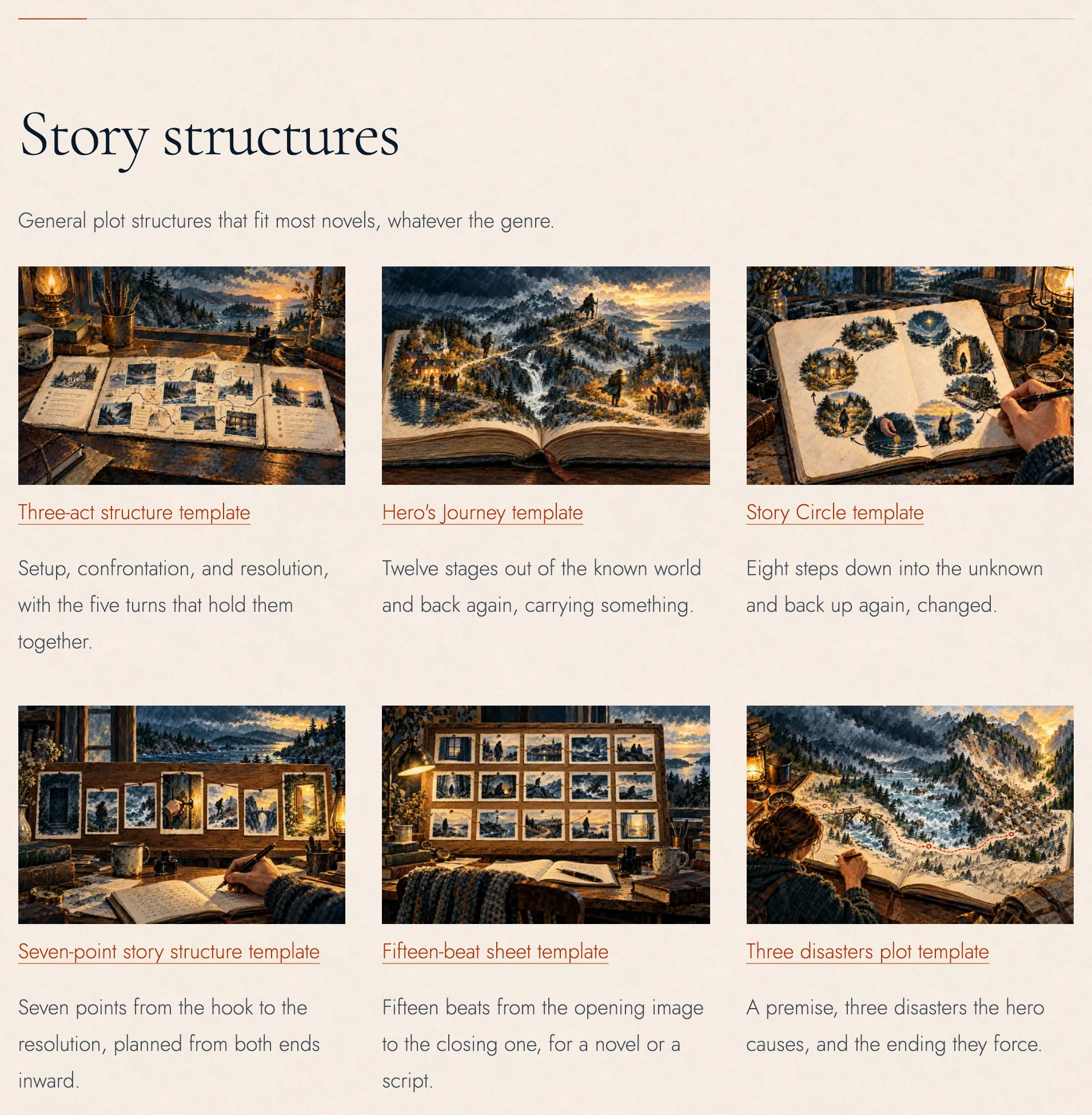
The public Templates library contains 26 worked examples and planning sheets. Each article describes when the structure fits and offers Download for Word or Print or save a PDF.
The Word file carries the named parts, their purpose, space to plan your own work, and the worked example. It is a planning copy you can edit independently of Tabularia.
- Choose a template by the writing task and read its worked example.
- Download it for Word or print a planning copy, if that is where you want to work.
- To start in Tabularia, press Open in Tabularia under the template page’s Open this template in Tabularia heading. A Book shape reaches New Project with its structure selected; name the Book before creating it.
Article and screenplay templates lead to Tabularia's starter-and-shape workflow. The worked example stays in the article; it is not copied into your prose. Blank Chapters remain yours to write.
The public library and Tabularia's 28 shapes are different catalogs. A shape can be available in Tabularia without a downloadable article. For other planning and revision aids, see Free writer tools.
10. Continue reading
Try it on your own book
Start a free evaluation. No card needed.