One typeset book for your writers, your editors, and your client.
For firms that write books with other people. Your team owns the manuscript, and everyone who reviews it reads the real page.
Book a 20-minute walkthrough See the price
How it works in your line of work
- Ghostwriting firms and book studios → For firms that match clients with writers, memoir studios, and studios that write books for executives.
- Book publishers → For fiction houses with long rosters of series authors, and for single imprints inside larger groups.
- Literary agencies → For editorial agents who work a book over before it goes out, and agencies with rights and screen desks.
- Book packagers and IP studios → For studios that develop long series under a house name, with freelance writers and a licensor who signs off.
- Author services and hybrid publishers → For hybrid publishers and author-services firms whose editors and project managers carry many client books at once.
- Serial and audio fiction publishers → For publishers of long LitRPG, progression, and romance serials, and of audio-first originals.
- Microdrama, game, and audio-drama studios → For writers’ rooms at short-drama studios, the transmedia teams that write a game’s tie-ins, and audio-drama producers.
- Writing schools and MFA programs → For low-residency and online MFA programs, continuing-studies certificates, and private schools that pair writers with mentors.
- Writers’ guilds and associations → For guilds and genre associations that offer member benefits and run critique groups or mentorships.
What your client sees
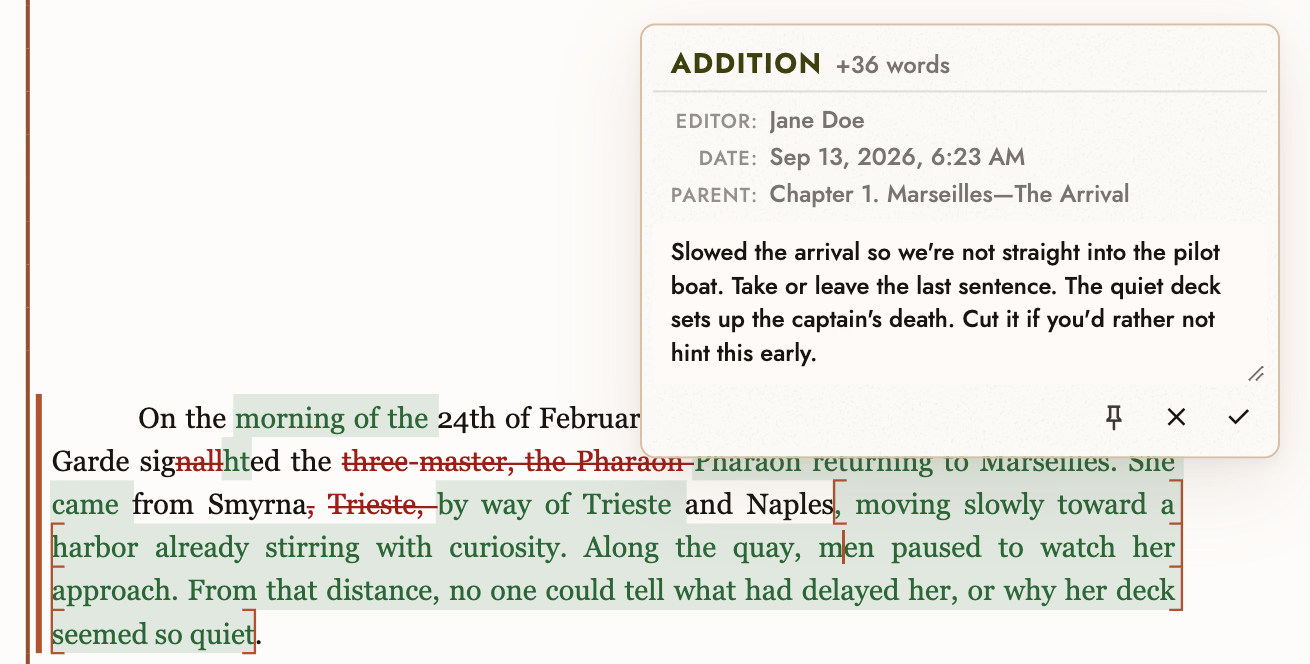
Your client never gets a file. They accept an invitation, sign in with the address you invited, and read their chapters set as a book, with the chapter openings and ornaments the finished copy will have. Reviewing costs them nothing.
When something should change, they mark it beside the passage. Your writer sees each proposal where it belongs and takes it or leaves it, one at a time or all at once. Three rounds of comments arrive as three sets of proposals on one manuscript, not as three Word files that someone has to reconcile on a Friday night.
The book stays with your team
A manuscript the team owns belongs to the team, not to whoever happens to be writing it. Replace a writer halfway through and the book stays where it was, with its drafts, its snapshots, and the record of who changed what.
Everyone on the team takes a seat and holds a role on each book. A Lead Author or Co-writer writes, an Editor proposes, and a Reader reads. Joining the team doesn’t open every book, so a confidential one is seen only by the people you give it to. Groups let you hand a whole imprint, client, or cohort a book in one step.
A writer’s own manuscripts stay in their personal workspace. One they move into the team stays in the team.
Controls for books that aren’t out yet
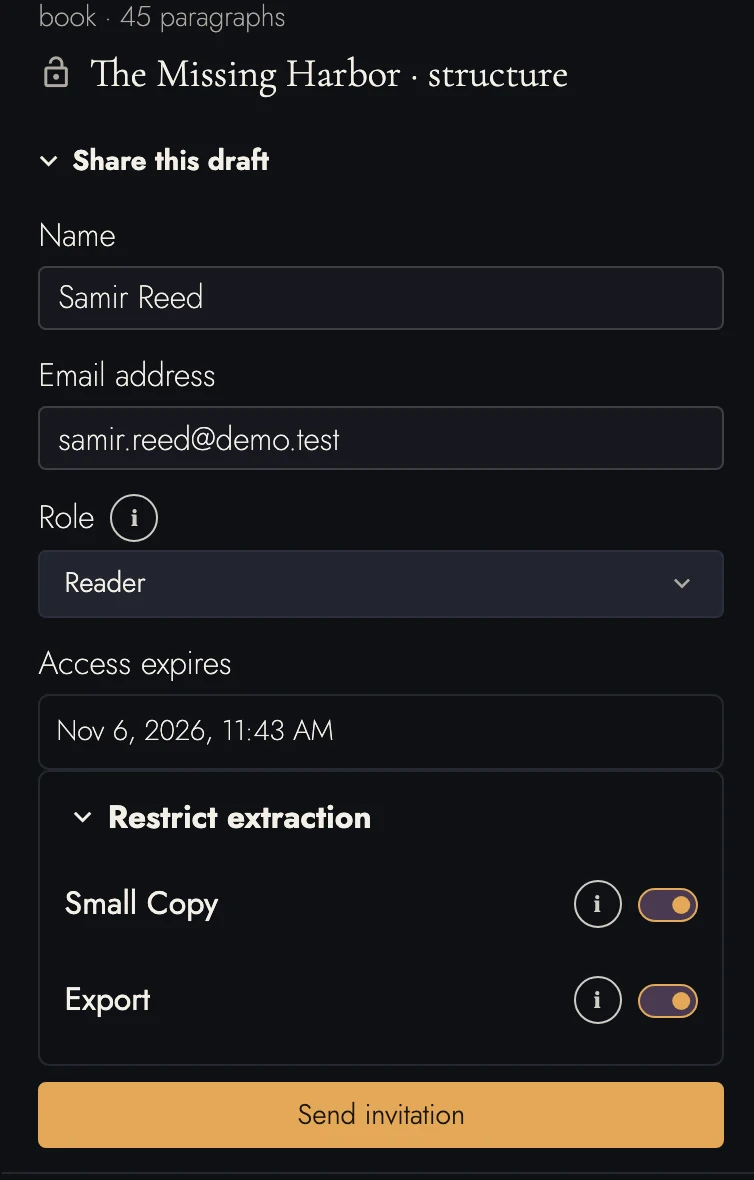
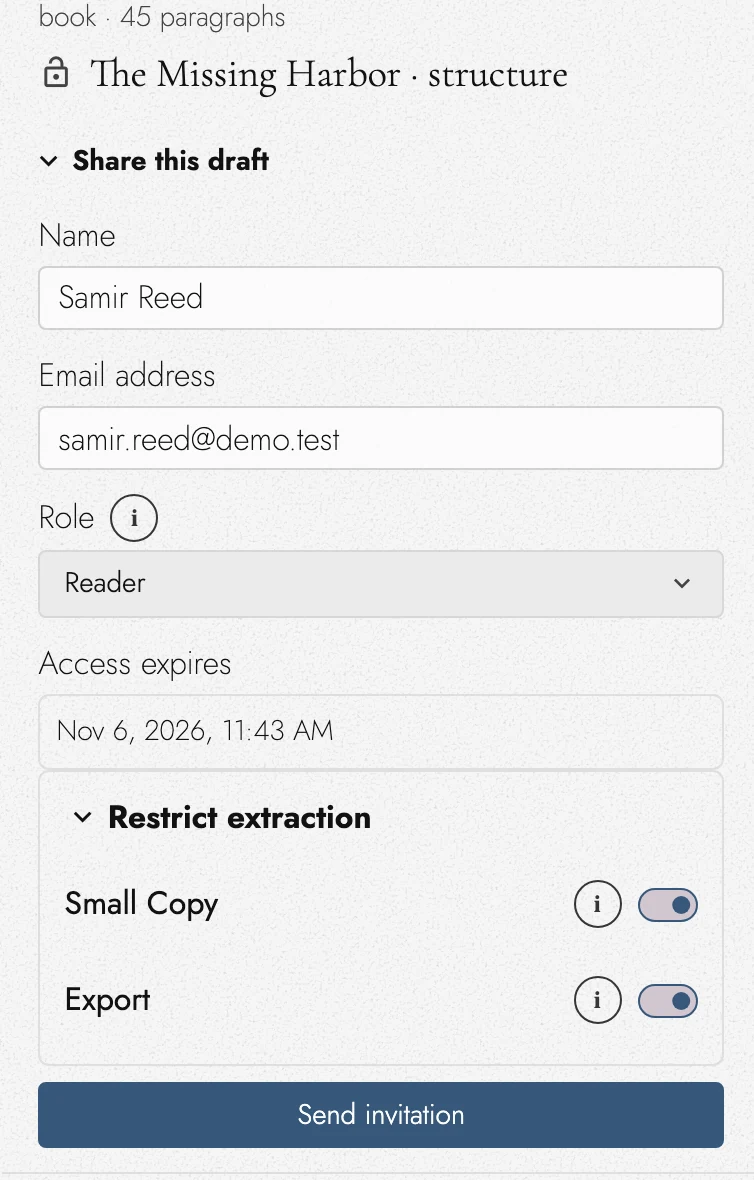
The team decides who may review, share, and export. Each share can also carry its own limits:
- a date the access ends, which also ends an Editor’s access to work already in hand;
- a copy limit of three paragraphs in a row;
- no export at all.
Administrative changes, such as who was given access, are kept in an audit history. The limits make lifting a manuscript harder. They can’t stop a screenshot or a patient typist, and nothing can.
View light appearance
Long books, long series, many hands
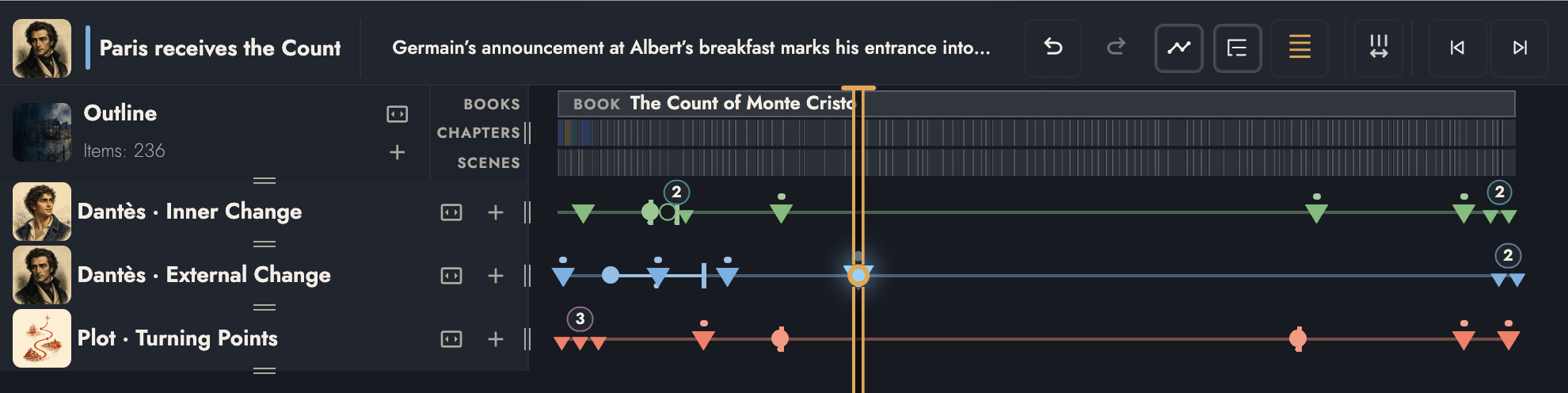
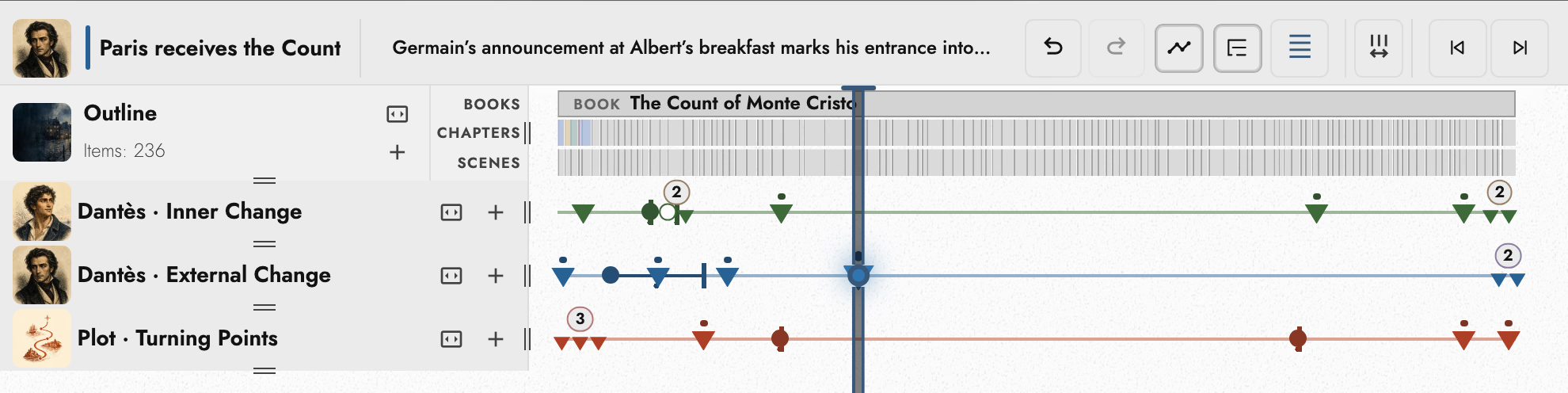
A series lives in one manuscript, book after book. Timelines hold a character’s arc or a promise from the first book, anchored to the passages that carry it, so the writer who picks up book seven can follow a thread back to where it started.
Length doesn’t slow it down. In our browser benchmark a keystroke reached the screen in under 20 milliseconds at a million words.
View light appearance
The price
$35 per seat a month, billed yearly, or $40 billed monthly. A team starts at 3 seats. Clients and outside reviewers join free and never take one.
A yearly plan can be paid by invoice, and from 50 seats an invoice is how it is paid.
What buyers ask
Do you train AI on our books?
No. Tabularia doesn’t sell manuscripts or train AI models on anyone’s writing. Manuscripts are encrypted in transit and at rest.
Can we take our books out?
Yes, whenever you like, as Word, PDF, EPUB, or print-ready files. See the export guide.
Single sign-on?
Not yet. If your security review needs it, tell me and I’ll tell you where it stands.
Can two people type in the same draft at once?
No. Writers take turns, and reviewers work in drafts of their own that come back as proposals. That is what keeps an edit from landing on top of one in progress.
Start with one book
I’m Allen, and I built Tabularia. I set up every new team myself. Pick a book you have in progress and I’ll run it with you for 14 days, free, so you judge it on your own work and your own client.