Edit book four with book one in reach.
For fiction publishers and the imprints inside larger groups. Your house owns the manuscripts, each series lives in one project, and editor and author pass one typeset book between them instead of a stack of Word files.
Book a 20-minute walkthrough What it costs
One series, from book one to book four
Here is a fourth book going through an imprint. Fallowfield Crime is an invented digital-first imprint of an invented house, Fallowfield Books, and its people and its series are made up too. Nadia Brennan is the in-house editor. Jonah Pell is under contract for four books about Detective Sergeant Lena Haig, whose brother vanished the night a pier burned in book one. Book four, Low Water, goes back to that night.
Put the whole series in one project.
The first three books come in from their final files, and book four from the chapters Jonah has written so far. From then on the series is one manuscript. Searching for the pier finds it in every book, and Jonah can narrow the page to the book he is writing whenever the other three get in his way.
Nobody has to remember which folder holds the copy that went to print.
Bring in a finished book

Follow the fire back to where it started.
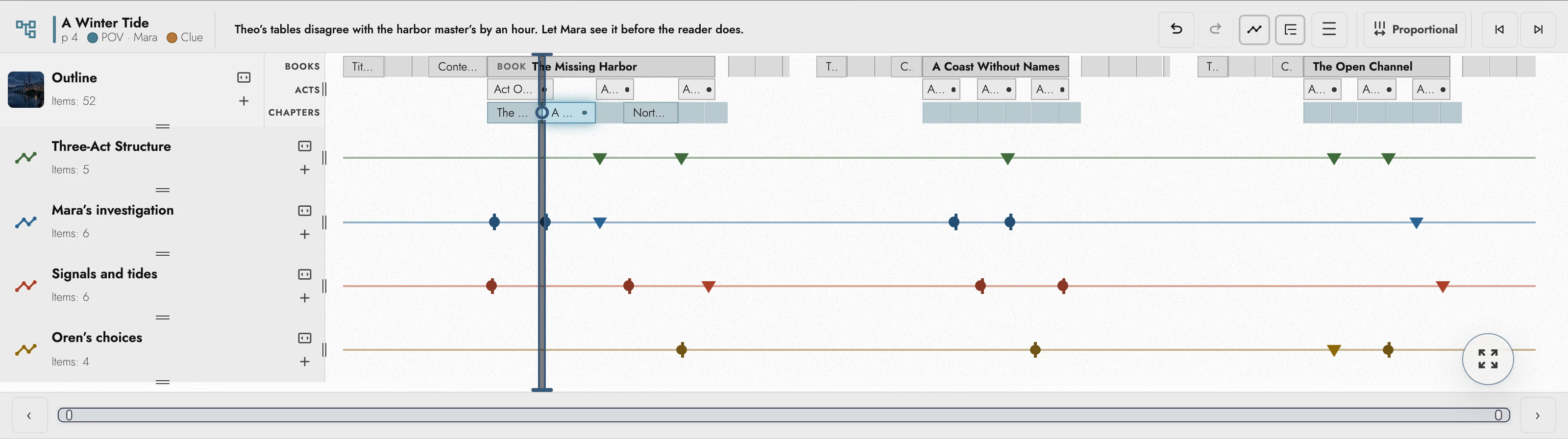
Continuity in a long crime series usually lives in an editor’s notebook, or in a spreadsheet one person keeps up. Here it lives beside the books. The series has a timeline for the pier fire, and each marker on it is pinned to the passage that mentions the fire, from the night itself in book one to Lena reopening the case in book four.
When a scene in Low Water says something about that night, Nadia selects the marker and lands on what book one said.
Keep a strand on a timeline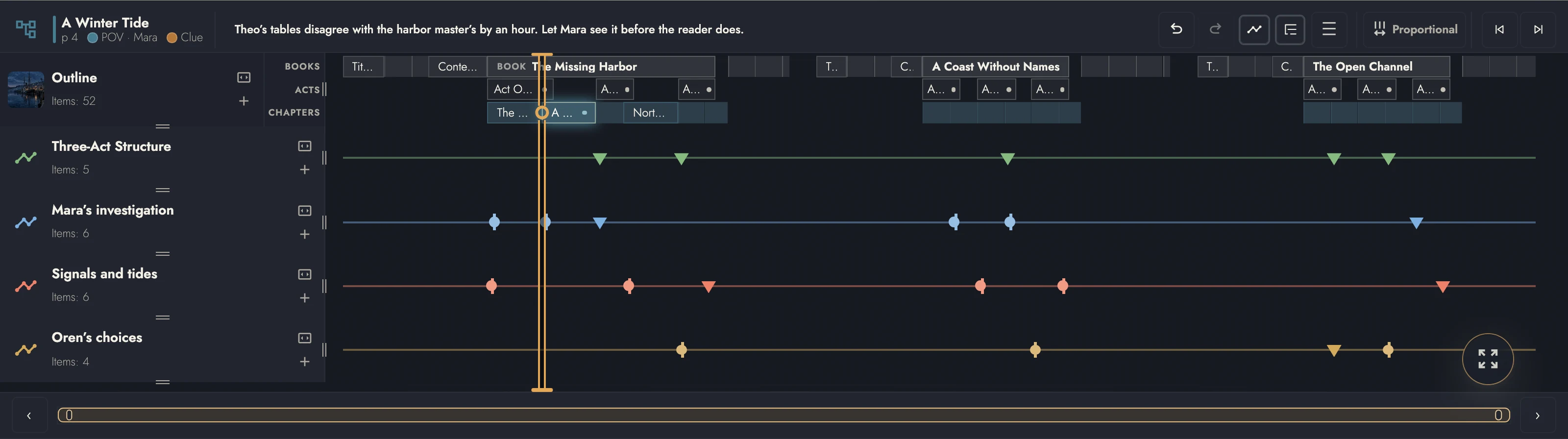
Nadia edits in a copy of her own.
Jonah sends the manuscript to Nadia for her edit, and she opens it in her browser. Whatever she types lands in a copy that only she can change, so nothing in Jonah’s text moves until he says so.
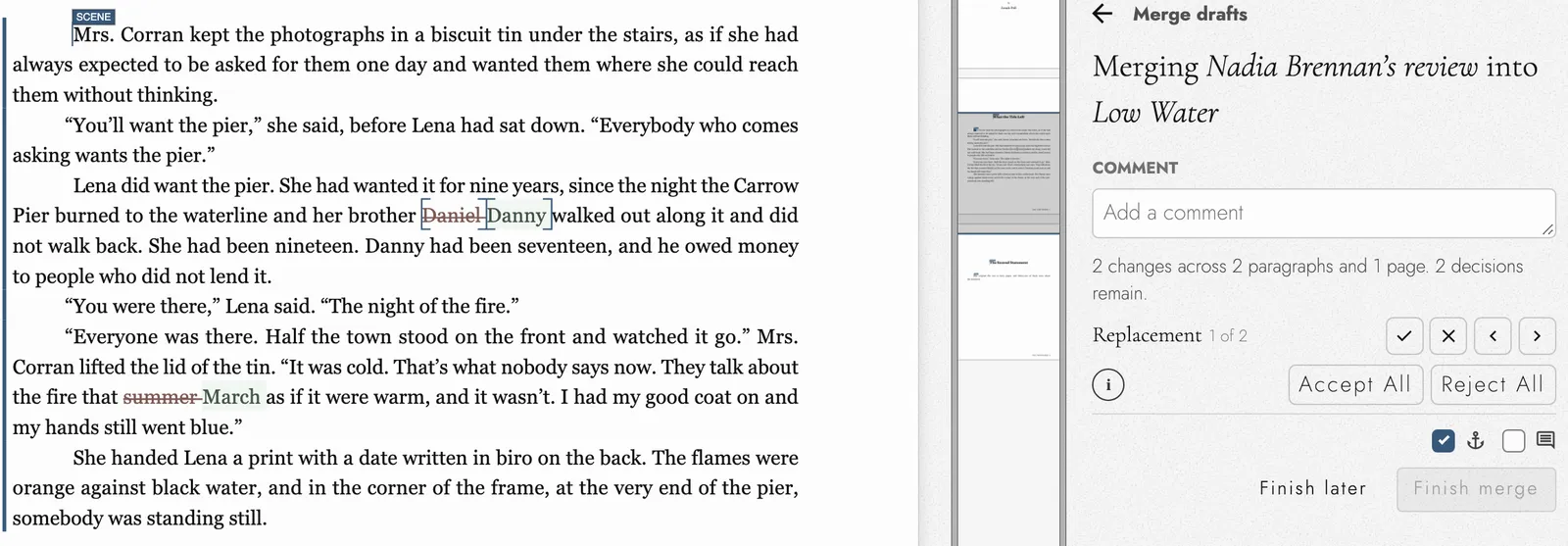
She catches two slips. Lena’s brother is Danny everywhere else in the series, and a witness remembers the fire as a summer one when book one put it in March. Nadia corrects both on the page and sends her copy back.
See an edit in Markup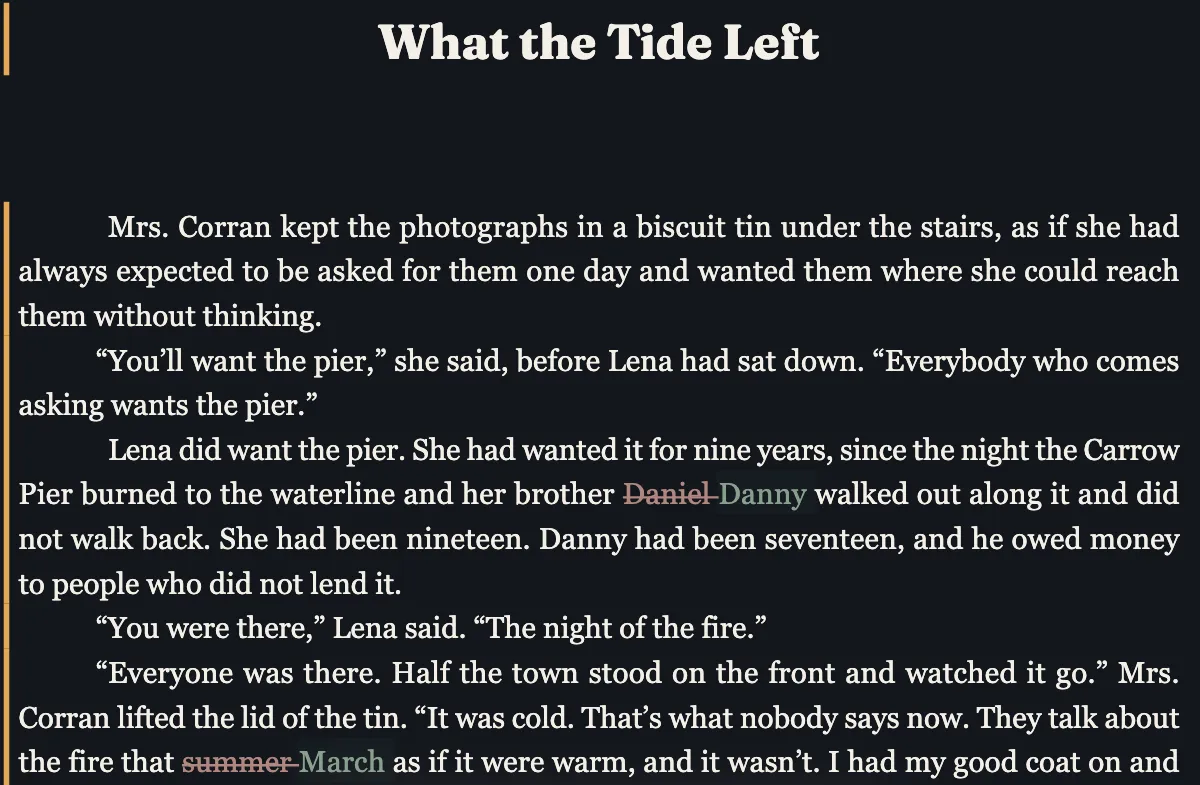

Jonah takes the edits he agrees with.
Nadia’s review comes back as proposals. Jonah steps through them on the page, accepting both corrections or turning down any he would argue with. There is no second file to reconcile and no tracked-changes round to number.
The page he accepts them on is already set as the finished book will be, so proofs aren’t the first time anyone sees one. When the book is ready to go, it leaves as an EPUB, a print-ready PDF, or a Word file for whoever still needs one.
Merge a returned edit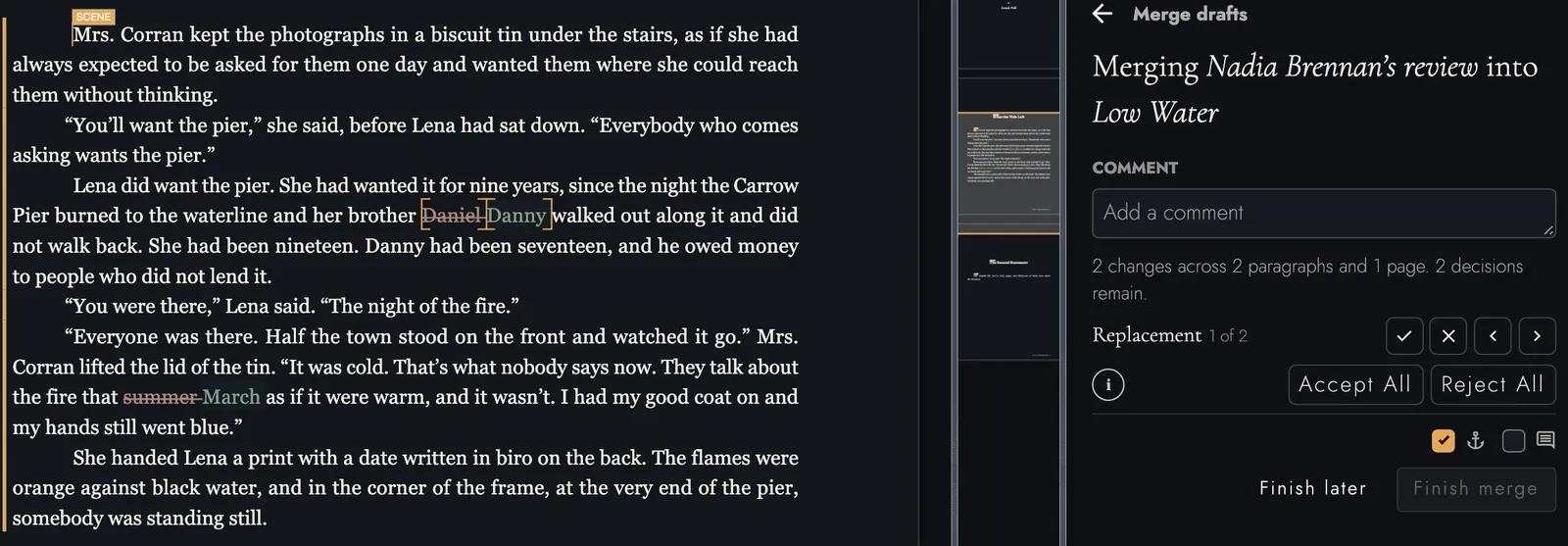
One imprint at a time
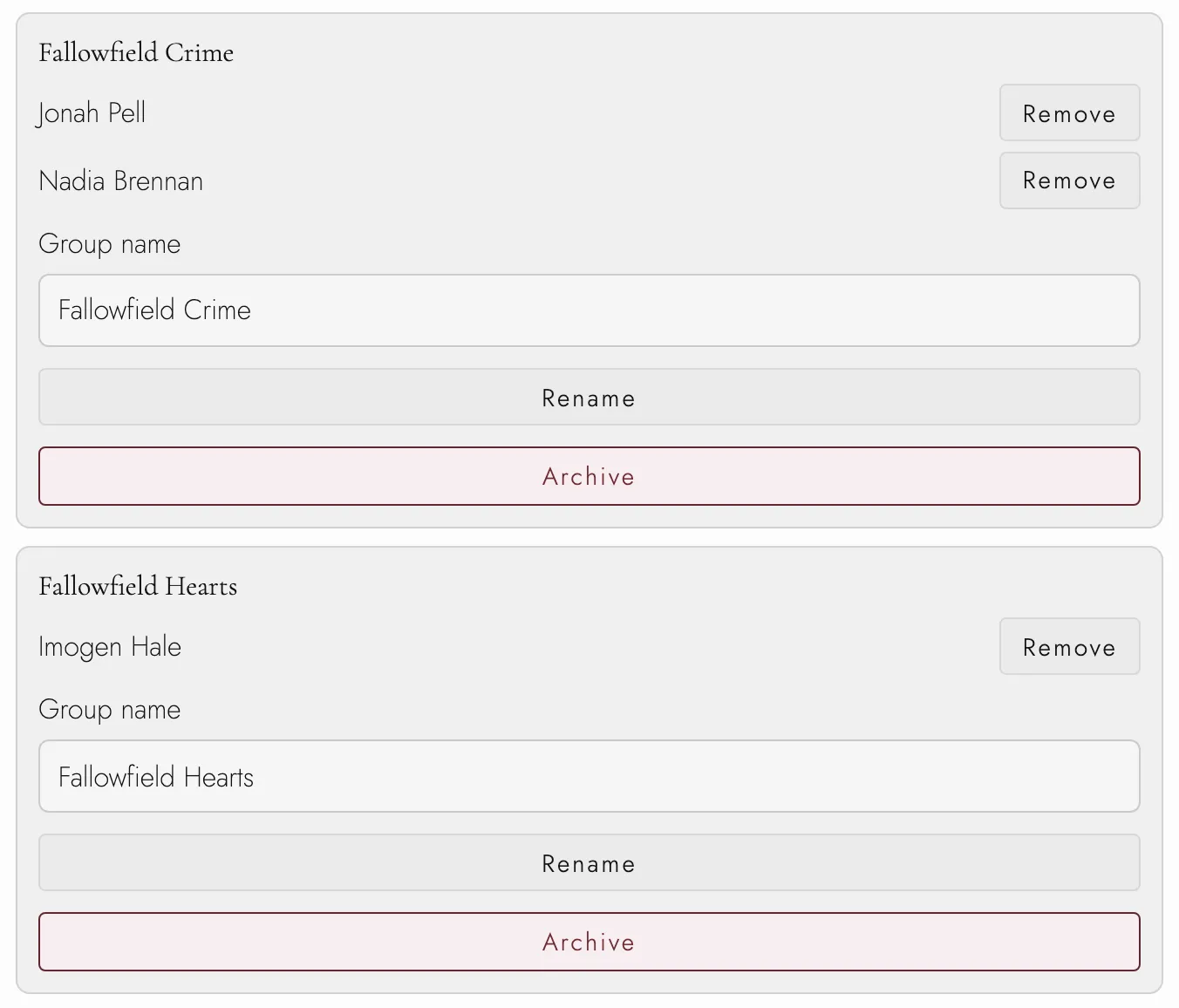
A publishing group seldom moves every imprint at once, and it shouldn’t have to. Start with one. Make the imprint a group on your team, put its editors and the authors who write in its books into it, and hand the group a series in one step instead of inviting six people to it one by one. When a second imprint or an acquired list comes over, it gets a group of its own.
Manuscripts written for the imprint belong to the team, not to the author’s personal account, and an author who moves a book in can’t take it back out. If an editor leaves, the series stays with its drafts and snapshots, and someone else takes it over. The team’s audit history records who was given access to what.
Questions you’ll have
Does every author need a seat?
Only an author who writes in your team’s manuscript. One who only reads a chapter and suggests changes joins free as a guest, and a team member decides what goes in. Who pays for a contracted author’s seat is between your house and the author; the team assigns it either way.
Our group’s security review will ask for single sign-on.
Tabularia doesn’t have it yet, and I would rather you heard that from me now. Manuscripts are encrypted in transit and at rest, never sold, and never used to train AI models. That is part of why I suggest piloting on one imprint before anyone asks for the whole group.
Can we bring in a list we just acquired?
Yes. Word files and Scrivener projects both import, and so do most other formats a list arrives in. Comments come across wherever Tabularia can pin them to a passage. Tracked changes arrive resolved, and the import reports how each was settled. Import formats.
Do you handle languages other than English?
Yes, in twenty-four European languages. German is one of them, which matters to a house starting a German list, and each book is typeset in the conventions of its own language. Chinese, Japanese, Korean, and the languages of India aren’t supported yet. Supported languages.
A pilot first, then seats
I’m Allen, and I built Tabularia. I set up each team by hand. Choose one series from a single imprint, with the editor and author already working on its next book and we’ll run it in Tabularia together for 14 days, at no charge, with the people who already work on it.
After the pilot, a seat is $35 a month on a yearly plan or $40 month to month, from 3 seats. Seats are for the people who write and edit. A client, an author, or any other outside reviewer joins as a guest and pays nothing.
Book a 20-minute walkthrough How team accounts work Every plan and price