A whole season in one script your studio keeps.
For short-drama studios, the teams that write a game’s novels and lore, and audio-drama producers. Every episode sits on a screenplay page that runs a minute, the canon is pinned to the lines that carry it, and your head writer rules on every note.
Book a 20-minute walkthrough What it costs
One season, from the first script to the showrunner’s notes
Here is a season going through a small writers’ room. Ribbon Street Pictures is an invented microdrama studio, and The Heiress at Table Nine an invented series of sixty short episodes; nobody named here is real either. Dana Okafor is the head writer, and Leo Marsh, a staff writer, drafts a share of the episodes. Ruth Calder is a freelance showrunner the studio hired for this season. She reads every episode before it shoots.
Bring in the episodes the room already wrote.
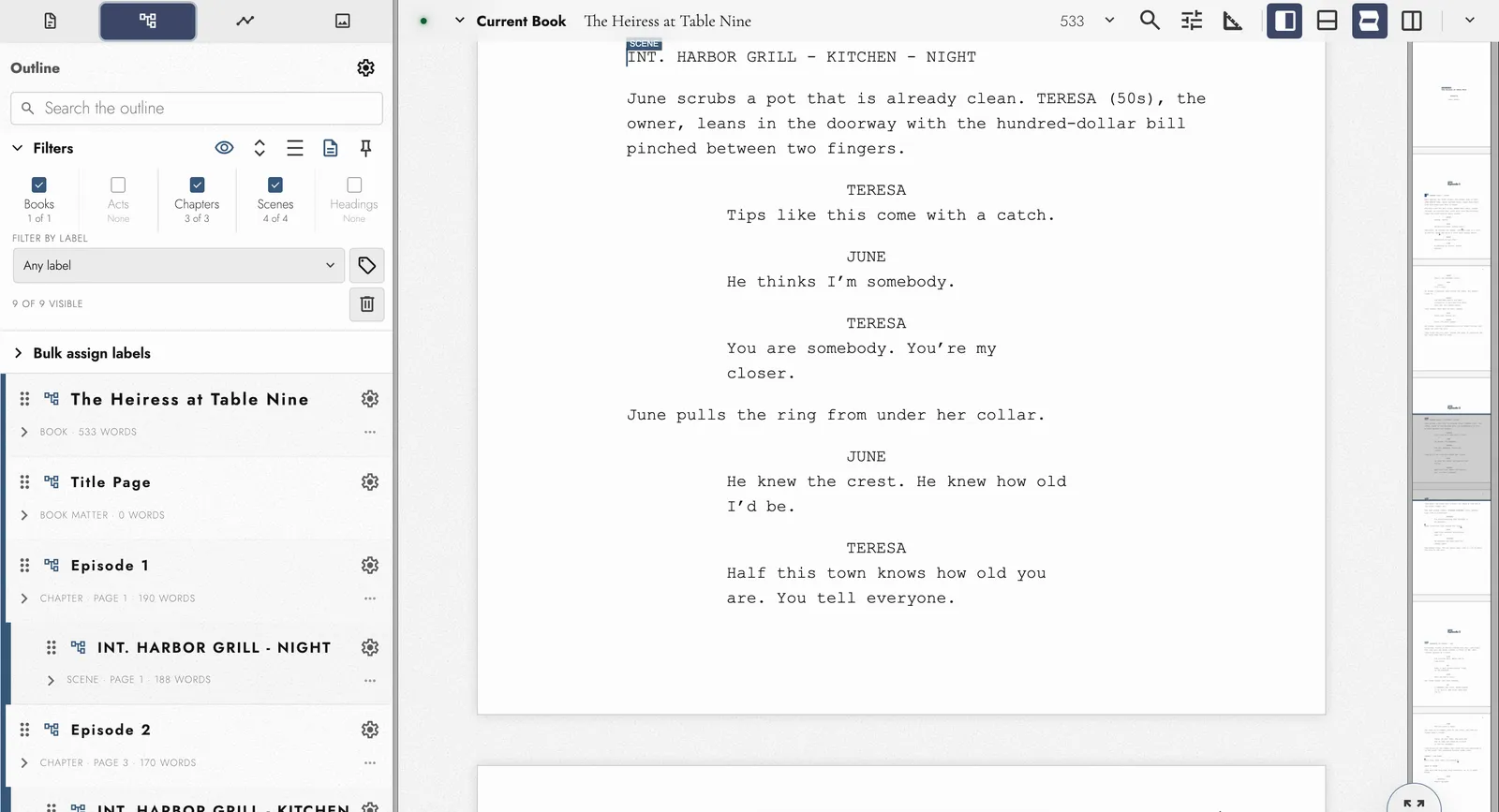
Dana wrote the opening episodes in another script app. She imports the Fountain file, and each section headed Episode becomes a chapter in the Outline, with its scenes under it. Scene headings, cues, and dialogue arrive as the same elements. A Final Draft file comes in the same way.
The page is the industry grid, so a page is a minute of screen time. If an episode meant to run a minute spills onto a second page, Dana finds out while she is still writing it.
Import a Fountain or Final Draft script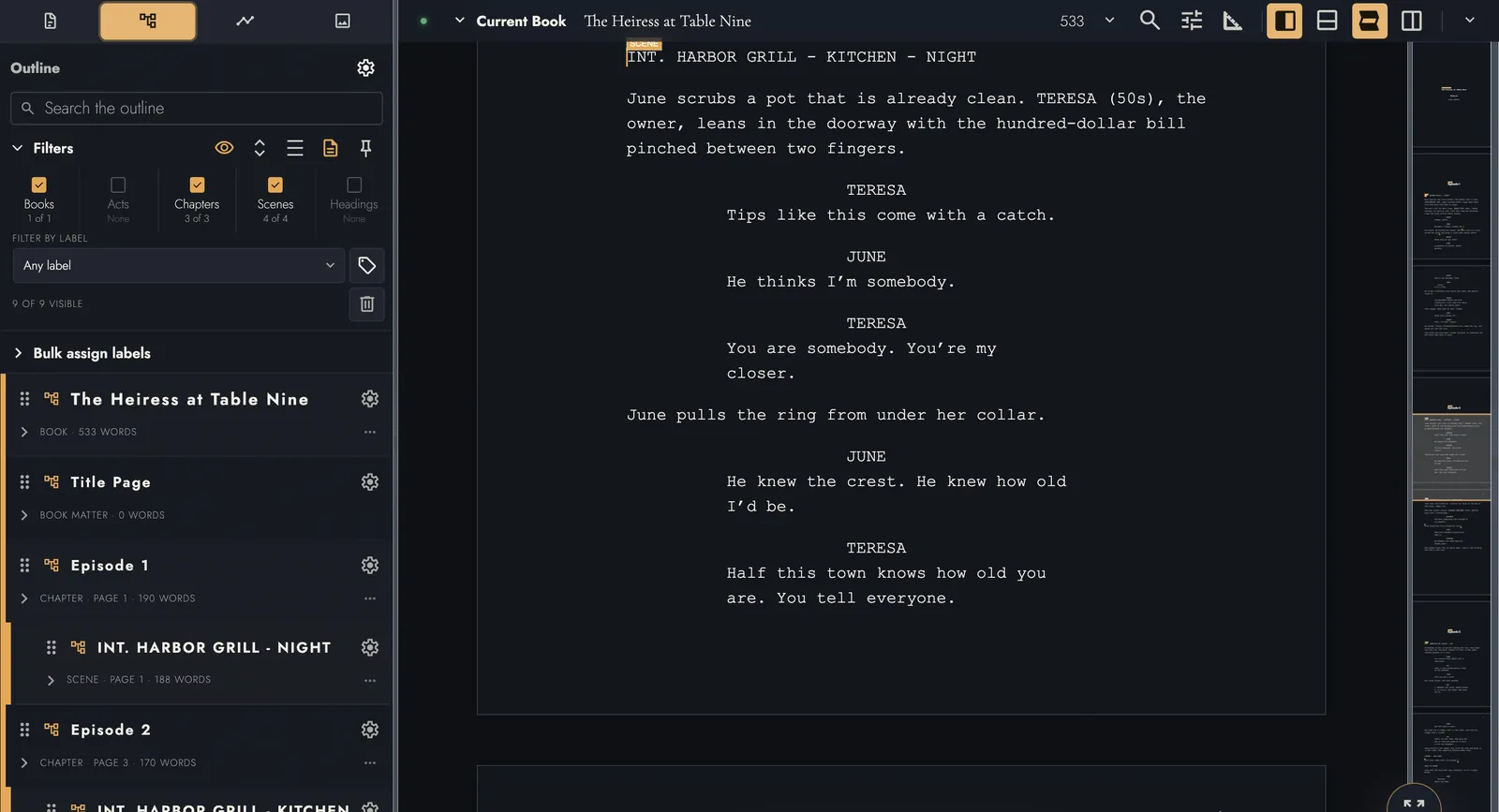
Pin the series bible to the lines that carry it.
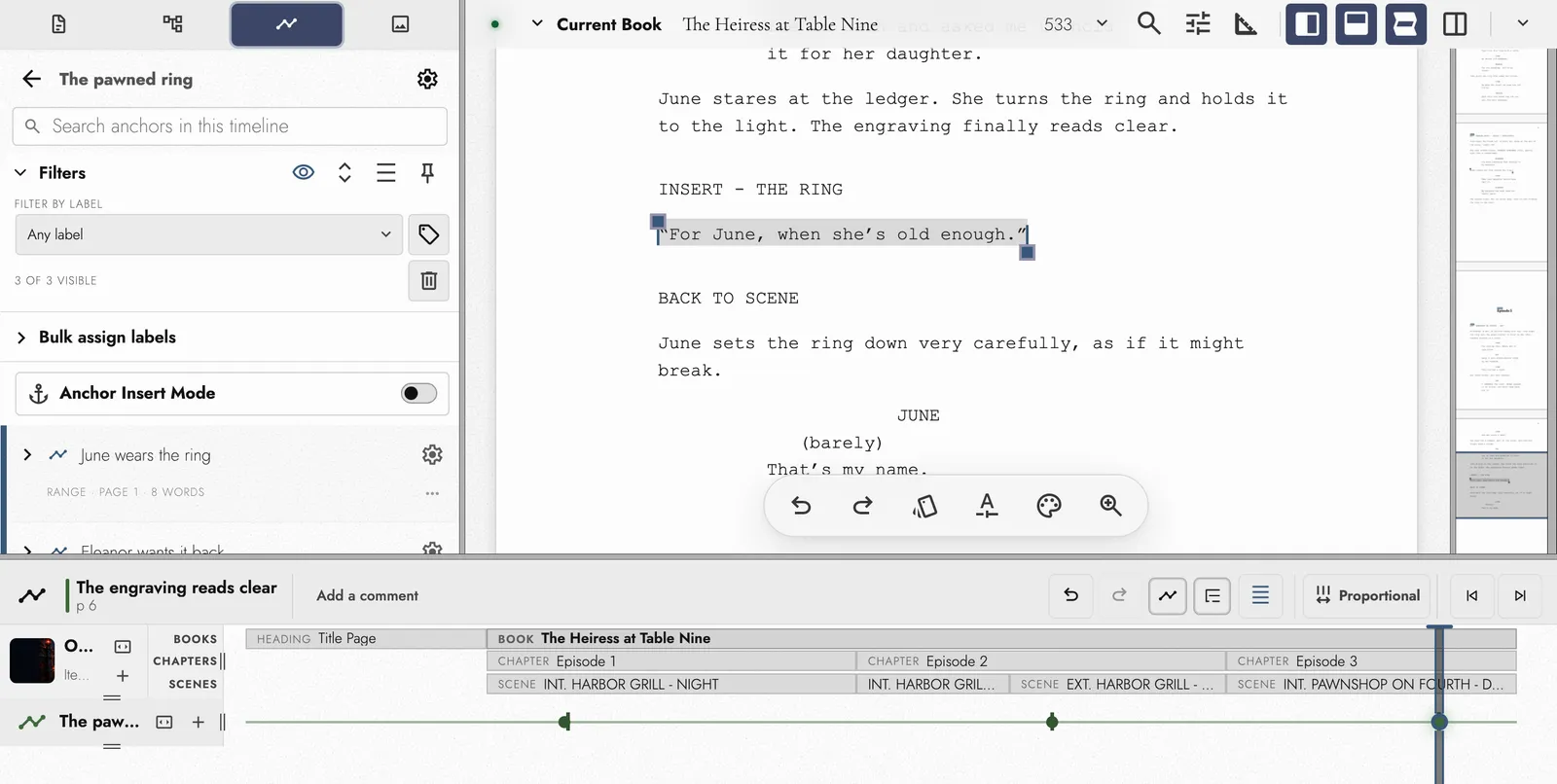
A season written by several people drifts. June buys a ring from a pawnshop for eleven dollars in episode 1, and its engraving pays the story off much later. Dana keeps that thread on a Timeline called The pawned ring. Each marker on it points at the line in the script where the ring matters.
Leo picks up a later episode and steps along those markers instead of rereading everything before it. A game studio’s tie-in novel works the same way, with a faction’s history pinned to the chapters that must agree with what the game already shipped.
Follow a thread with a Timeline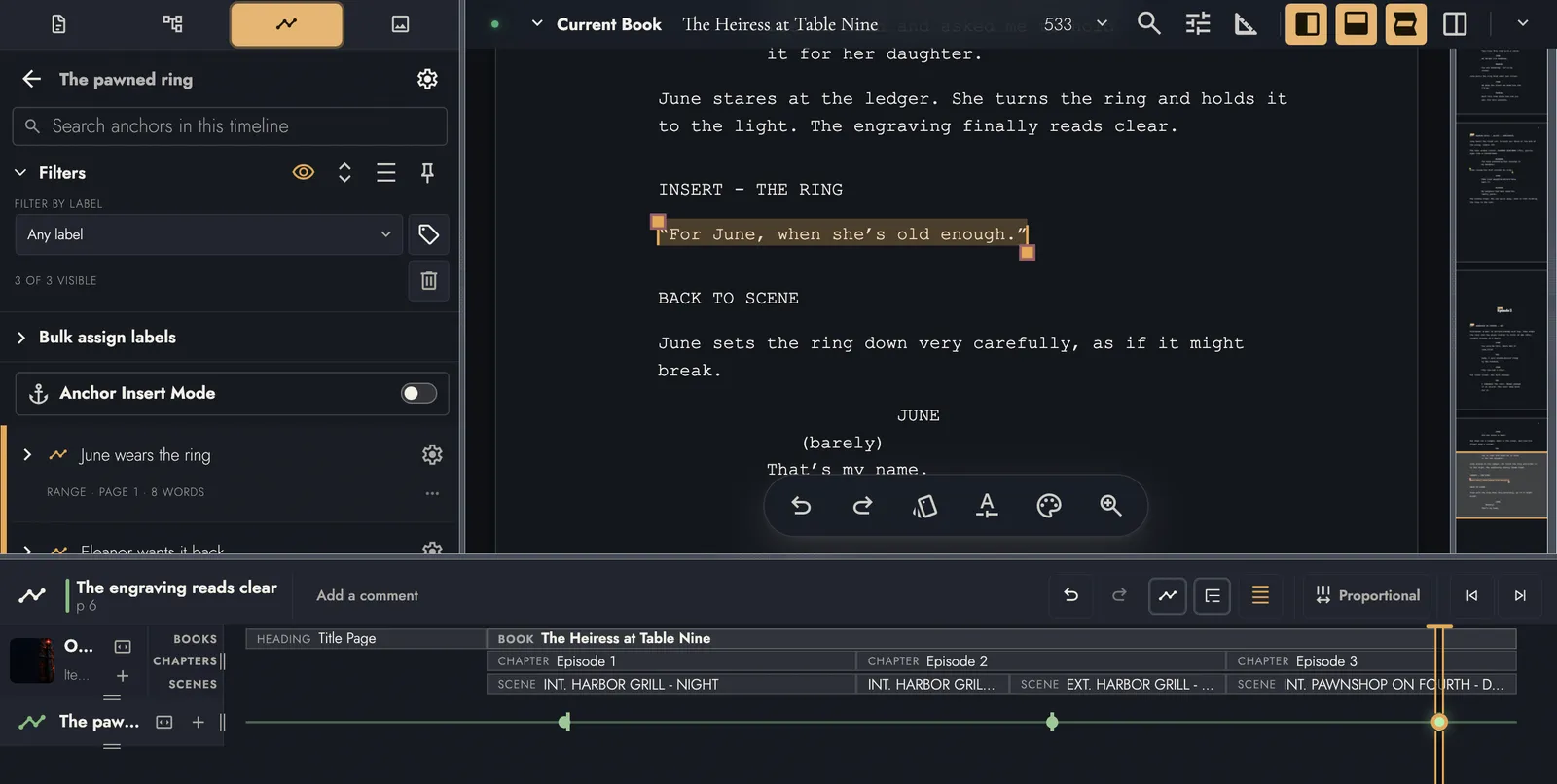
Send the scripts to Ruth, who never pays for a seat.
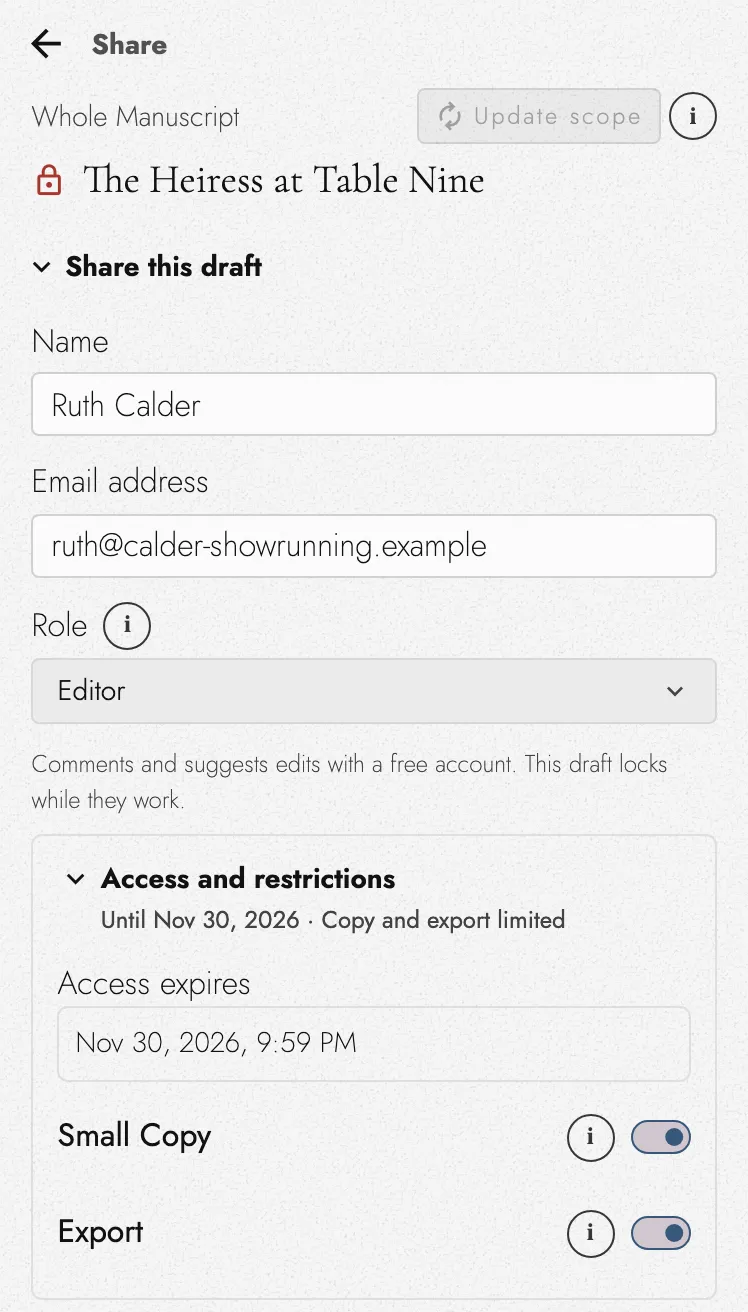
Ruth works for several studios and has no seat at this one. Dana invites her by email to edit, ending the invitation when the season wraps, capping copying at three paragraphs, and switching export off. Ruth makes a free account with that address, and the season opens in her browser.
None of that stops a screenshot or someone retyping a scene. It does mean a freelancer can’t leave with sixty episodes in one export.
Invite a reviewer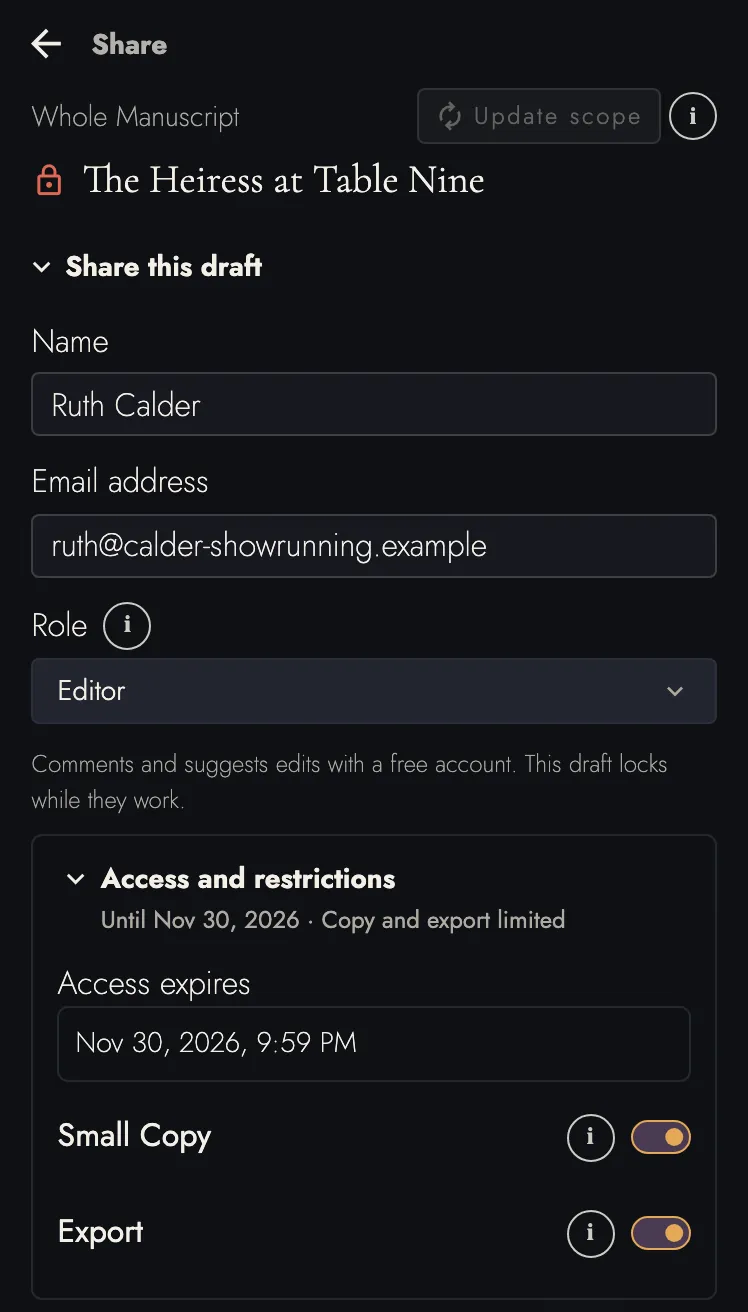
Dana takes the notes she agrees with.
Ruth edits a copy of her own. She rewrites Eleanor’s last line so episode 2 ends on its hook, changes one word of Teresa’s, and sends the copy back with a single button.
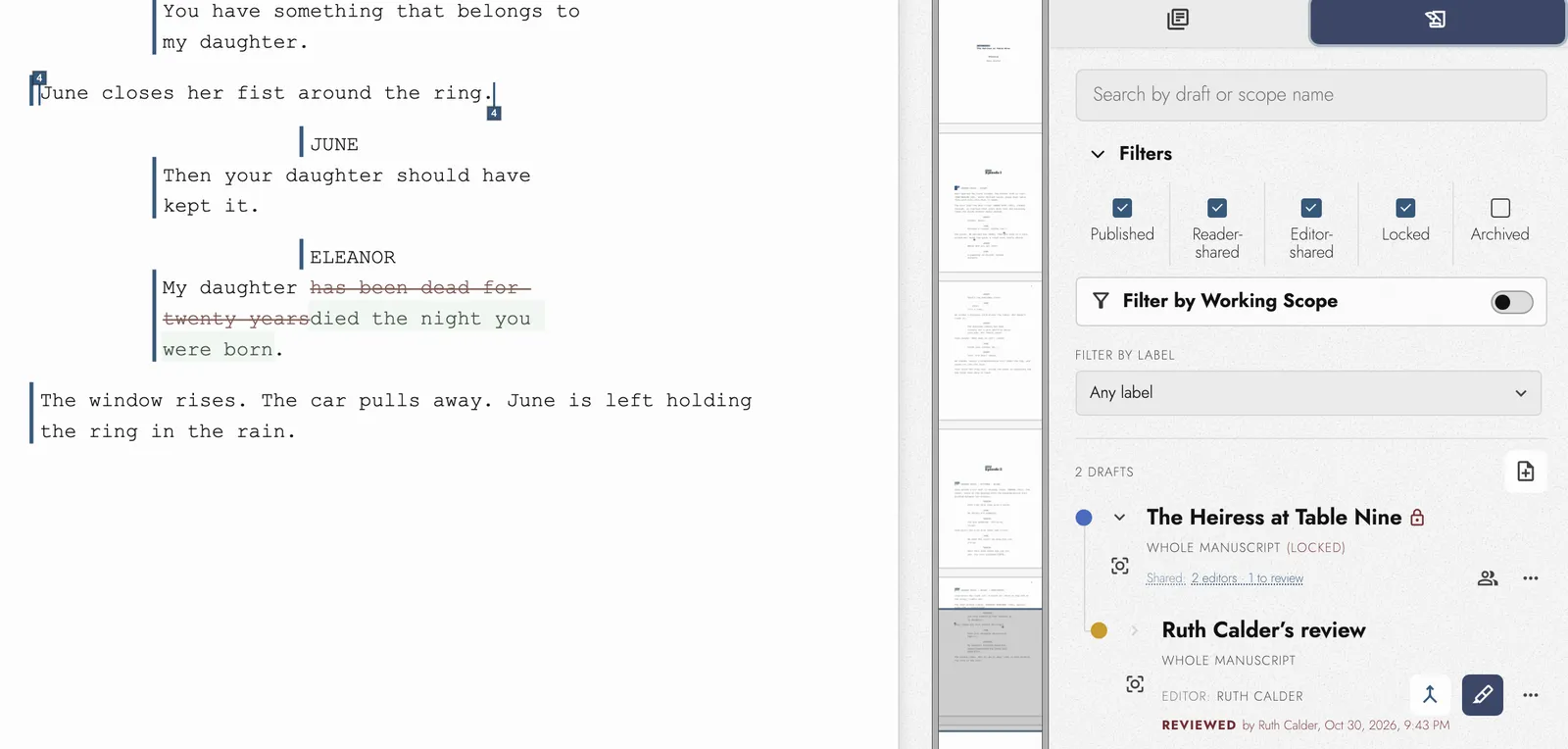
Dana opens the returned review and sees both changes struck and inserted on the script page, right where they fall. Nothing Ruth typed is in the script until Dana accepts it, one change at a time or all at once. The showrunner’s notes never sit in a chat thread waiting for someone to retype them.
Merge a returned review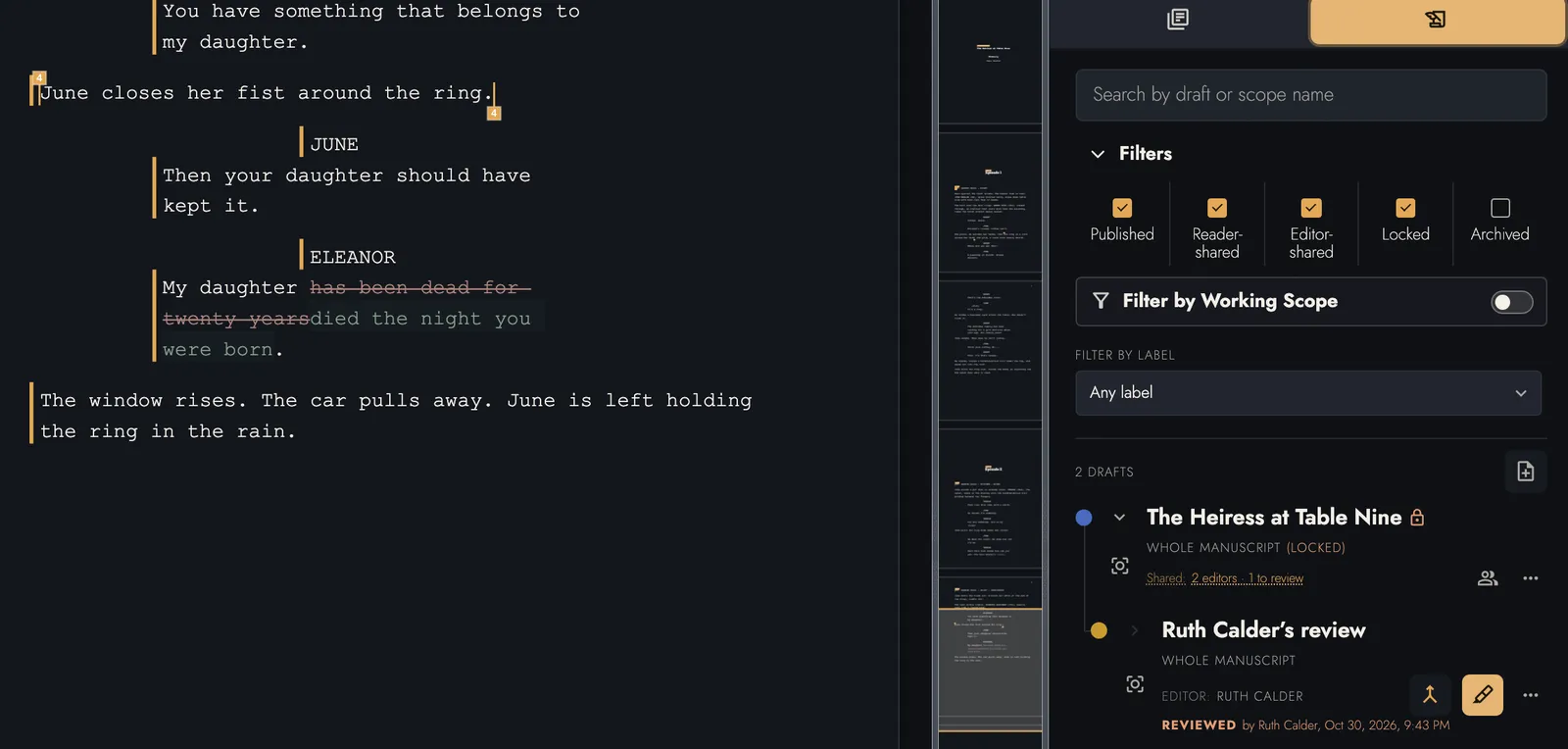
The season stays with the studio
Short-drama writers are often on contract, and a tie-in author may deliver one book and move on. The Heiress at Table Nine belongs to Ribbon Street Pictures. When Leo’s contract ends, his episodes stay with the studio, and so do the Timelines and every review Ruth sent back. Whoever looks after the team’s content hands his scripts to a new Lead Author.
A seat on the team never opened every project. A tie-in for a game nobody has announced can be marked confidential, so only the people you name can read it, and the team’s audit history keeps a record of who was given access and when. Writers take turns in a draft; two people don’t type in the same one at the same moment.
Questions you’ll have
Can we write branching or interactive scripts here?
No. Tabularia doesn’t read or write ChoiceScript, Ink, or Twine, and it has no branching format of its own. Keep choice scripts in the tools your engine reads. The linear writing around them belongs here, from the bible and the treatments to a cutscene script or a tie-in novel.
Which languages can a script be written in?
Any of the 26 languages Tabularia sets, English, Spanish, and Polish among them. Chinese, Japanese, and Korean aren’t supported yet. Neither are the languages of India, so a show written in Hindi would have to live somewhere else for now. Every language, and what it changes.
Our studio belongs to a large publisher. Will procurement accept it?
Possibly not yet. There’s no single sign-on, so each writer signs in with their own address, and I can’t hand a security team the attestations a big publisher usually asks for. A studio that buys on its own can start this week.
How do scripts get to production?
Export the script to Fountain or Final Draft for whatever production uses, or as a PDF for the table read. Scene headings and dialogue come back out as the elements they went in as. How export works.
A pilot first, then seats
I’m Allen, and I built Tabularia. I set up each team by hand. Choose one season or tie-in book your room is writing now and we’ll run it in Tabularia together for 14 days, at no charge, with the people who already work on it.
After the pilot, a seat is $35 a month on a yearly plan or $40 month to month, from 3 seats. Seats are for the people who write and edit. A client, an author, or any other outside reviewer joins as a guest and pays nothing.
Book a 20-minute walkthrough How team accounts work Every plan and price