A member benefit your guild doesn’t have to run.
For writers’ guilds and genre associations, from children’s writers to crime, fantasy, and westerns. Your members see their pages set as a book and get free review from their critique partners. Your guild gets a link for its newsletter and a cut of what members pay.
Book a 20-minute walkthrough What it costs
One member and her critique group
This is how it looks from one member’s desk. The Bramble Lane Society is an invented association of children’s writers, and everyone below is invented too. Nora Pell joined it while finishing The Case of the Silent Piano, the first in a middle-grade mystery series she hopes will run to five books. Once a month she trades chapters with Ben Corrigan and Lucía Ferro, the other two writers in her critique group.
Nora signs up through the society’s link.
The society put its link in the members’ newsletter. Nora follows it and the discount is taken off at checkout, so there is no code to dig out from behind a members-only login. Then she brings in the draft she has been revising for a year, and its chapters arrive as chapters.
Her pages are already set as a book. For a middle-grade writer that is worth having early. She can see where each chapter starts and stops on the page, and how long the book really runs, months before a designer gets near it.
Bring in a draft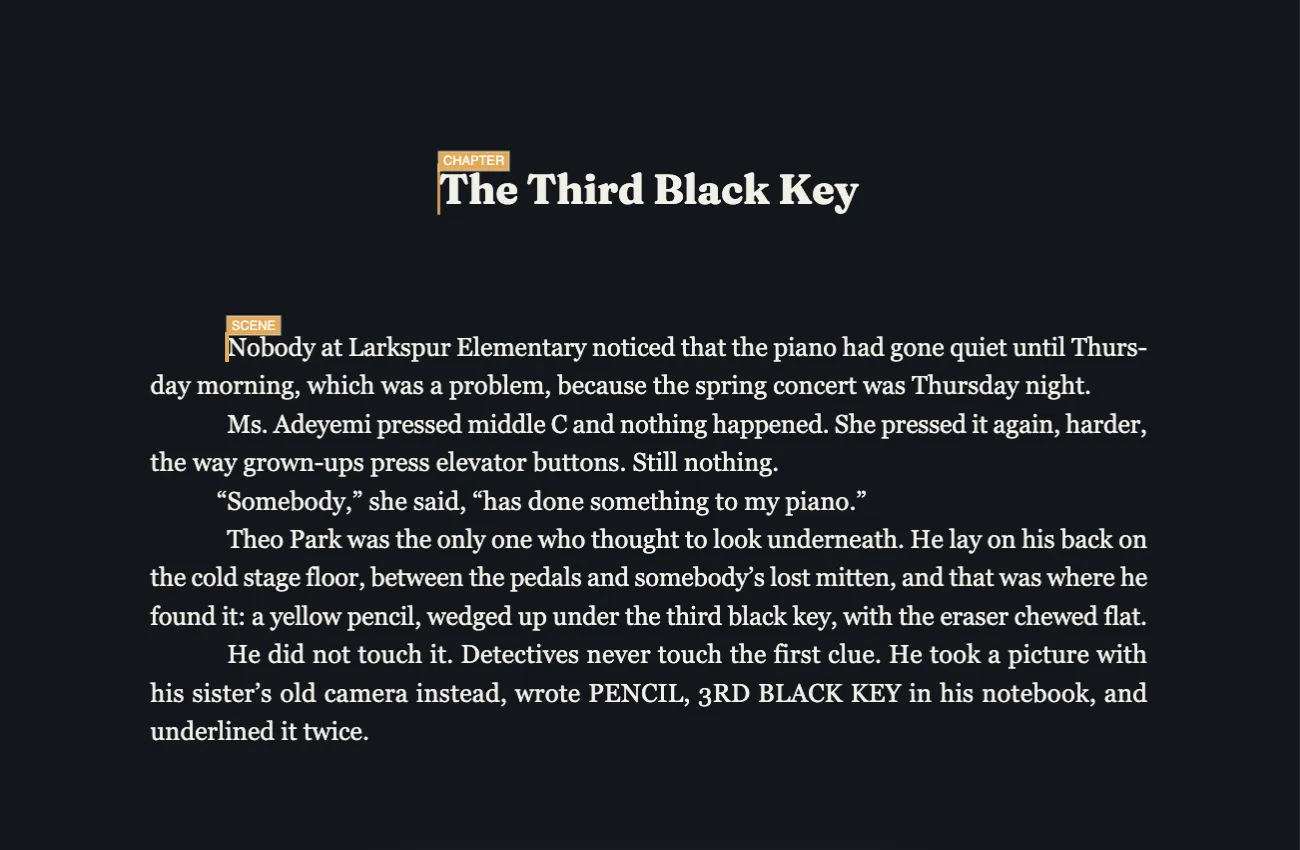
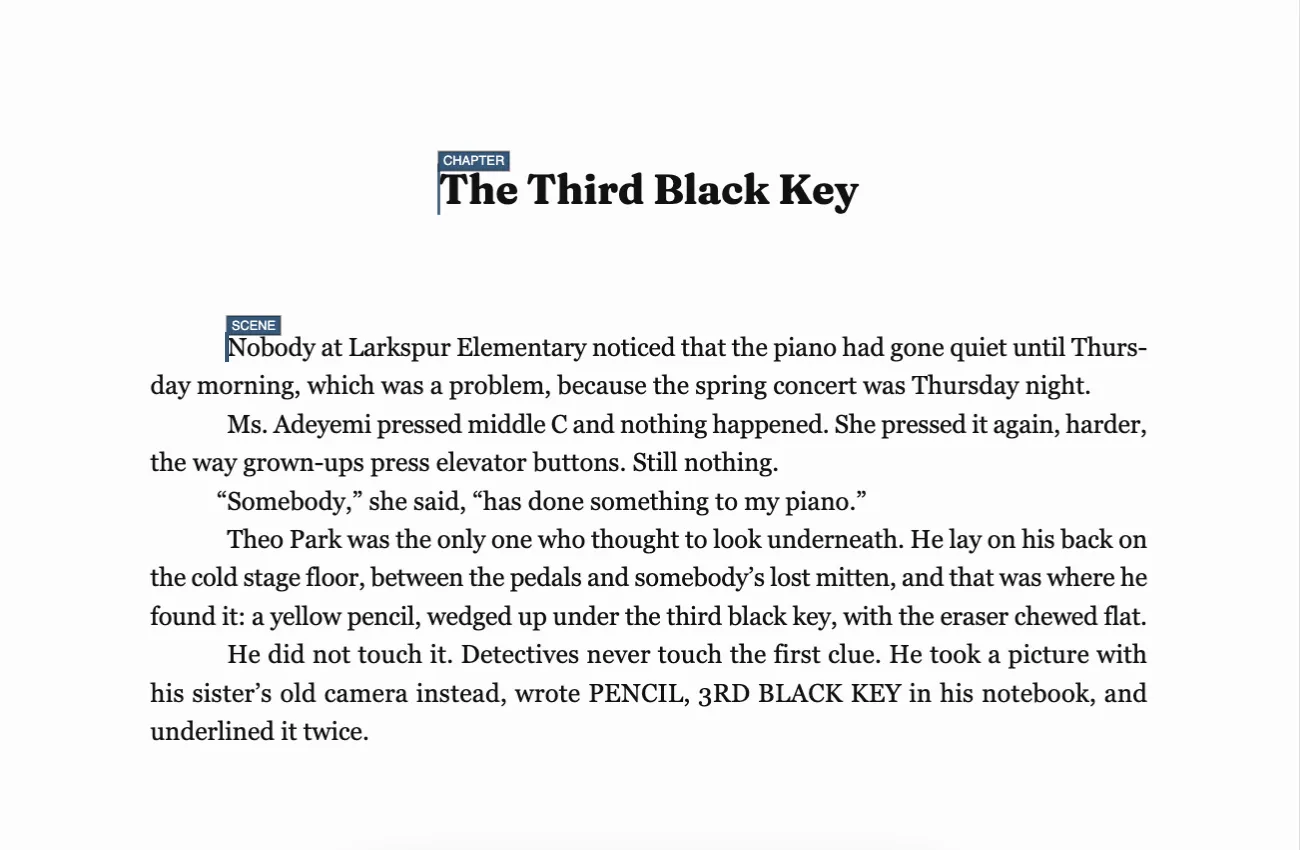
A timeline keeps her clues straight.
A mystery for young readers has to play fair. Children notice. The pencil Theo finds jammed under a piano key in the first chapter has to be the same pencil, under the same key, when the detectives work out who put it there. Nora gives the clue a thread on a timeline and anchors each passage that mentions it.
Pinned, the thread hides everything else and leaves only those passages, in order, so she can read the clue’s whole trail in a couple of minutes. A fantasy writer would do this with a magic system’s rules, and a historical novelist with dates that can’t move. When book two comes, it joins the same project and the thread runs on into it.
Anchor a thread to its passages

Ben and Lucía review for free.
Nora invites each critique partner by name and address, and gives both of them the Editor role. Neither pays, and neither has to belong to the society. They accept, make a free account with the address she used, and read her chapters on the very pages she sees.
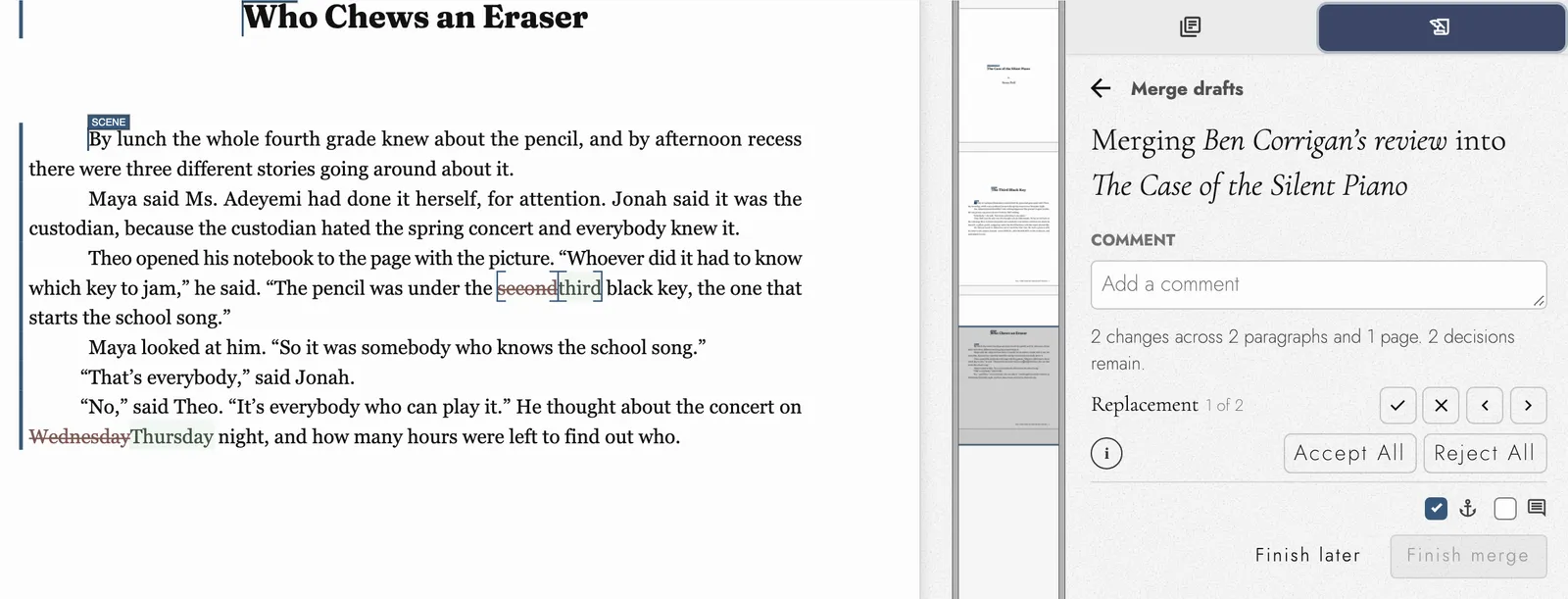
Each gets a copy of their own, so nothing they type reaches the book until Nora takes it. Ben does what a good critique partner does. He notices that the second chapter has moved the pencil to a different key and the concert to a different night, corrects both, and sends his copy back.
Invite a critique partner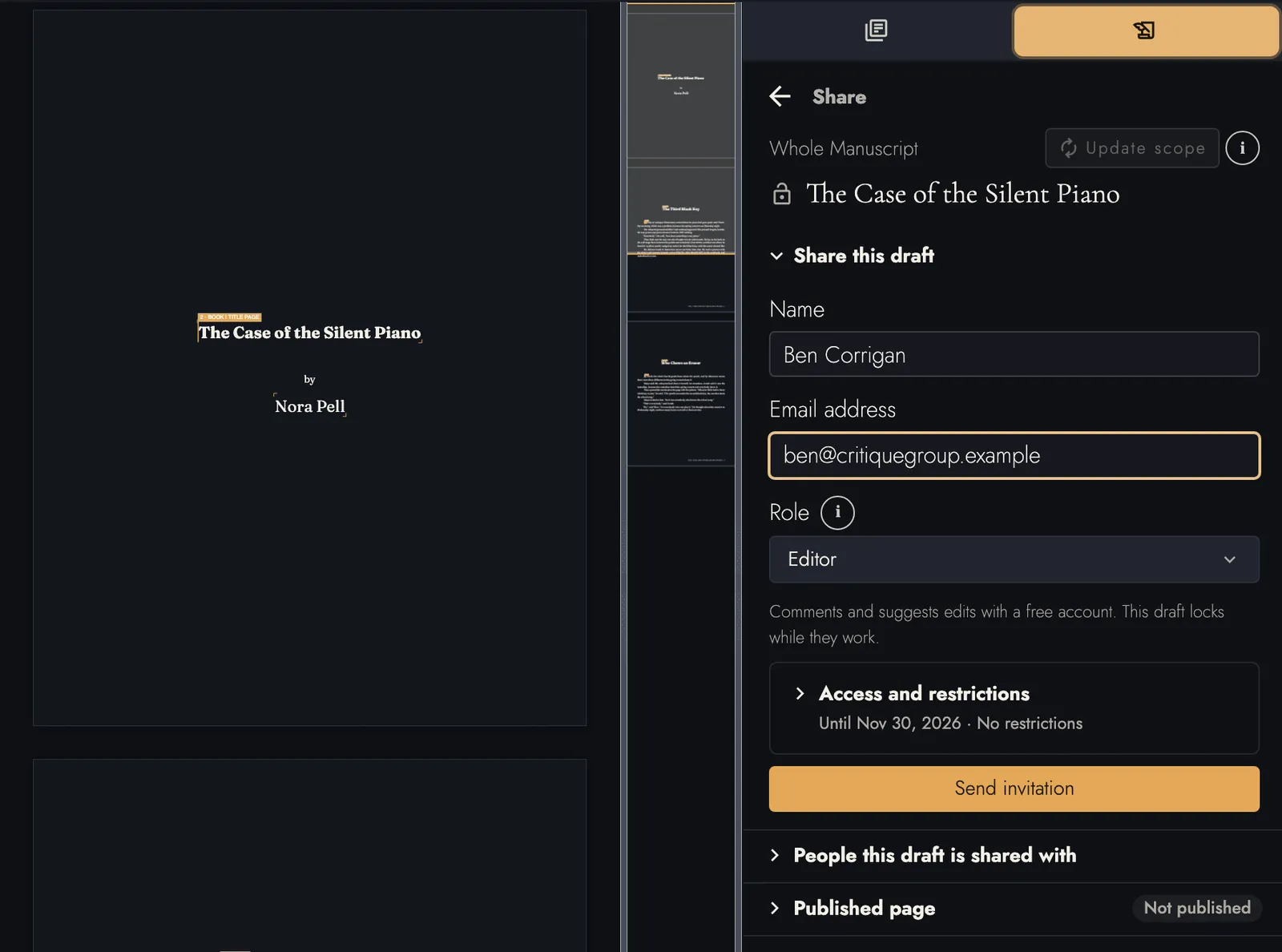
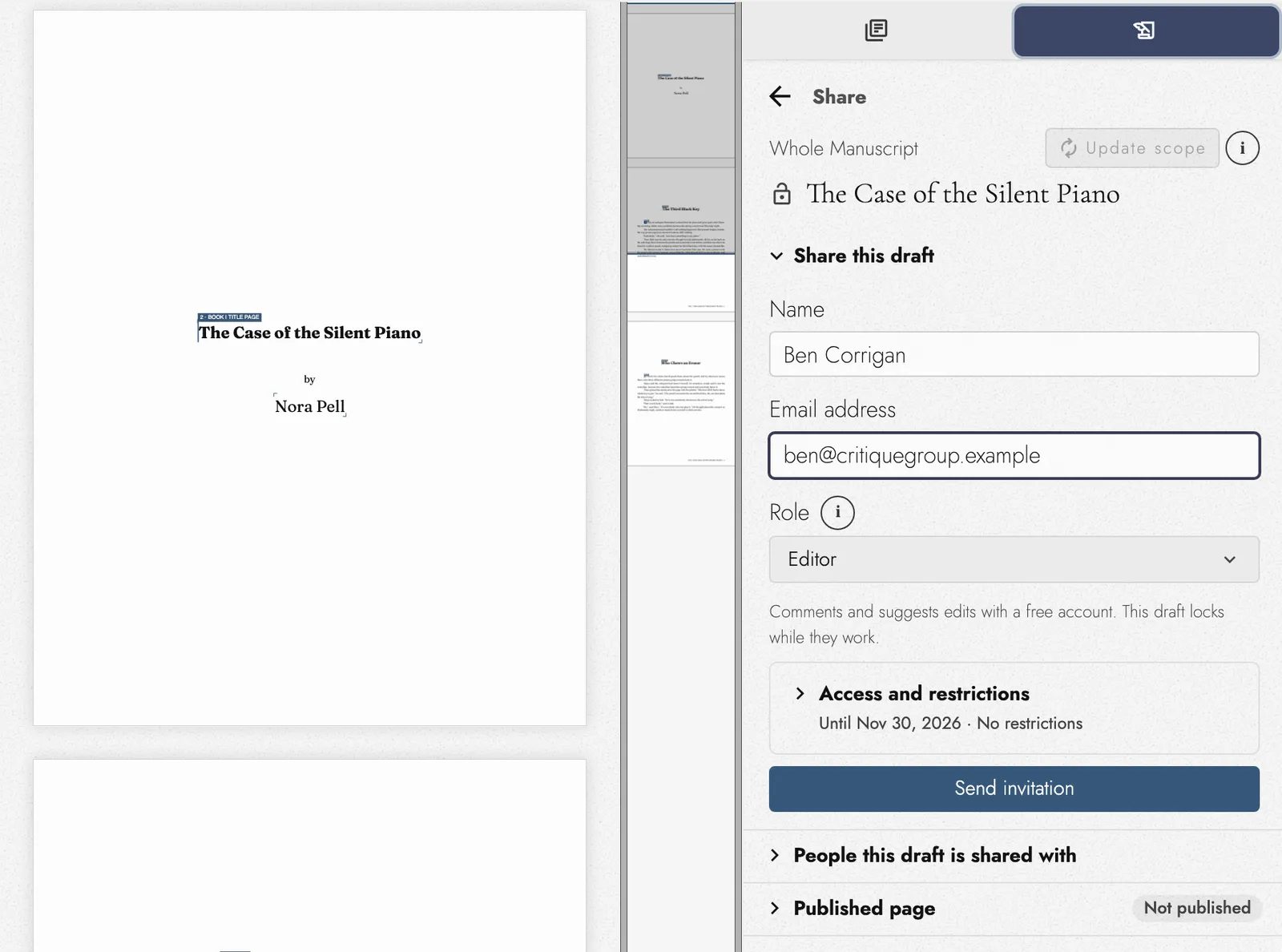
Nora keeps what works.
Two reviews are waiting the next morning. Nora opens Ben’s, turns on Markup so his changes are marked where he made them, and accepts both. Lucía thinks one of the playground theories needs a better motive. Nora isn’t sure yet, and that change can wait until she is.
A mentorship works the same way. A mentor’s edits come back to the mentee as proposals on the mentee’s own book, and the mentee has the last word on each one.
Merge a returned review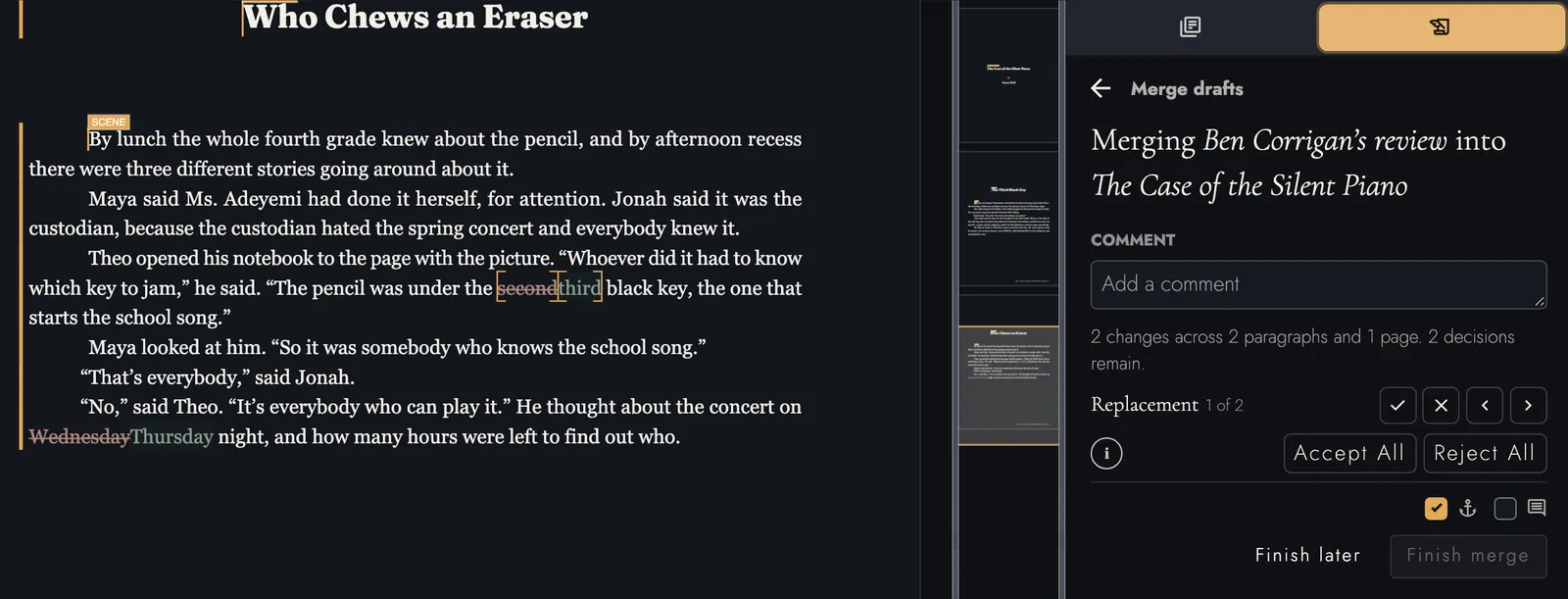
What your guild takes on
Very little. Members choose their own plan through your link and pay for it themselves. Their books stay in their own accounts, where nobody at the guild can open them, and the link takes care of the discount on its own. Your account page counts the clicks, sign-ups, and earnings it brings in.
While you’re a partner, the guild gets a free Cloud account, so whoever vets member benefits can try Tabularia on their own pages before it goes in a newsletter. We ask one thing in return. Wherever the link appears, tell members that the guild is paid when they use it, because a recommendation from their own association is one they will take on trust, and they’re owed the whole of it.
A mentorship program or a chapter’s critique groups may want a shared space instead. I can set one up as a team for a free pilot, with each book open only to the people it’s given to. A book moved into a team stays there, though, so a member who wants a book kept in their own name should share it from their own account.
Questions you’ll have
Does Tabularia train AI on our members’ books?
No. We don’t sell manuscripts and we don’t train AI models on anyone’s writing. Books are encrypted in transit and at rest, though not end to end. What I can’t give you is an AI-free certification. Tabularia has no AI writing of its own, but a writer may connect an assistant they chose, and nothing reaches one unless they do. How a writer connects an assistant.
What would a member pay?
Cloud is $20 a month, less the guild’s discount on the first year, and the Local plan is $219 once. Sharing chapters for review takes Cloud, so a member in a critique group will want that one. Their critique partners pay nothing, whichever plan the member holds. Both plans, side by side.
Will it lay out a picture book?
Not the way a picture book is made. Tabularia sets text on book pages and can place a picture in it, but a picture book is designed spread by spread around its art, and that remains a designer’s work. Picture-book writers can draft and trade their text here. Chapter books, middle grade, and YA are where seeing the real page pays off.
Our members don’t all write in English.
A manuscript can be set in any of 26 languages, Welsh and Irish among them, each with its own hyphenation and quotation marks. Chinese, Japanese, and Korean aren’t supported yet. Which languages, and how.
A pilot first, then seats
I’m Allen, and I built Tabularia. I set up each team by hand. Choose one critique group or mentorship pairing with pages to trade this month and we’ll run it in Tabularia together for 14 days, at no charge, with the people who already work on it.
After the pilot, a seat is $35 a month on a yearly plan or $40 month to month, from 3 seats. Seats are for the people who write and edit. A client, an author, or any other outside reviewer joins as a guest and pays nothing.
If you’d rather recommend Tabularia than buy seats, the Partners program gives the writers you send 20% off their first year and pays you 30% of what they pay for 12 months.
Book a 20-minute walkthrough How team accounts work Every plan and price