Edit the debut where it was written.
For literary agencies and the editorial agents in them. Your edits land on the sentences they are about, your client decides which ones stay, and the copy that goes out on submission belongs to the agency.
Book a 20-minute walkthrough What it costs
A debut, from the last pass to the co-agent
Larkhaven Literary is an invented agency, and A House Called Thursday an invented first novel. Nobody below is real either. Ruth Abernathy signed Nell Tavener in the spring and wants one more pass on the opening before the book goes out. Once it does, Marisol Vance, who sells film and television rights for Larkhaven from Los Angeles, will want to read it.
Ruth works in Nell’s own manuscript.
Nell writes in her own Tabularia account and invites Ruth to edit. Ruth needs no seat for this. She signs in with the address Nell used, and a copy of the book opens that is hers to mark up, laid out the way Nell’s pages will one day print.
The second paragraph gives two reasons Iris doesn’t cry, and the second one explains too much, so Ruth strikes it. A few lines on, the kitchen smells of “something she could not name”, and Ruth names it. Every edit sits on the sentence it belongs to. An editorial letter would have had to quote each one back, with a page number.
What an invited editor can do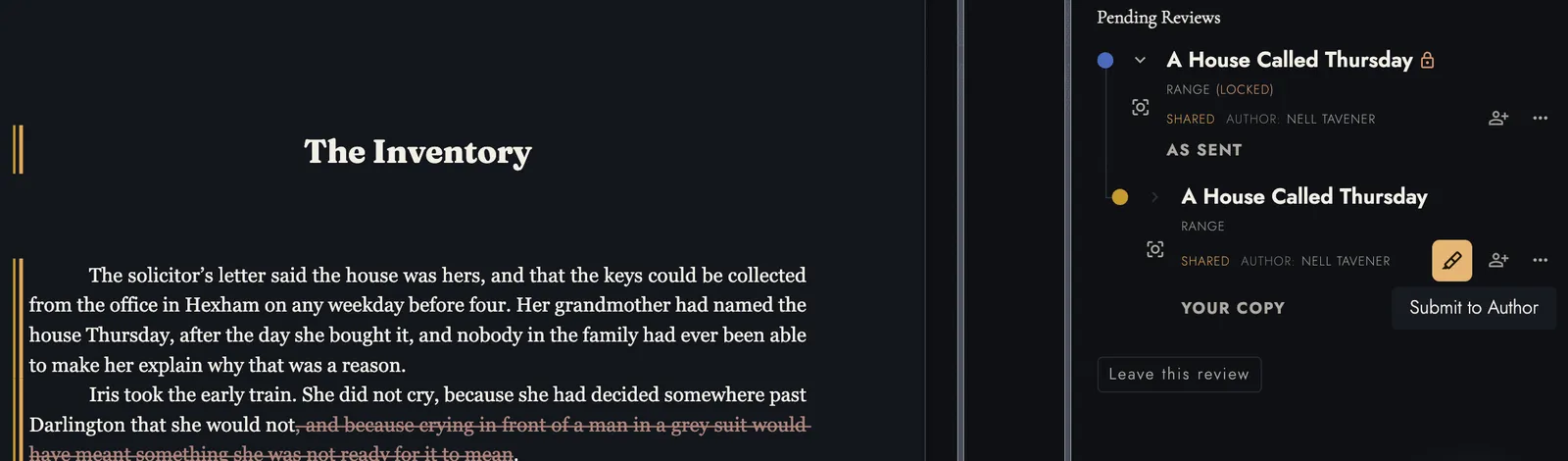
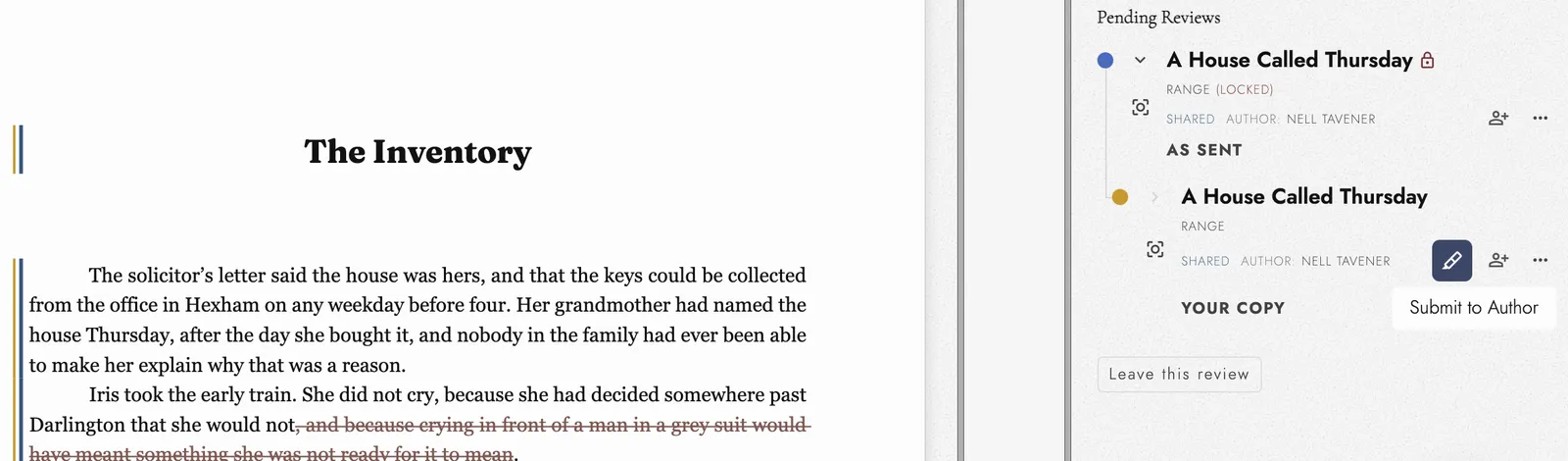
Nell keeps what she agrees with.
Ruth submits her pass. It comes back to Nell as a draft with Ruth’s name on it, listed under the version she shared, and not one word of Nell’s own book has changed while Ruth was working.
Nell walks through the merge a difference at a time. She keeps the cut, though it stings a little. Paraffin and oranges she takes too. Had she turned either down, her own sentence would have stayed, because Ruth only ever proposed.
Read and merge a returned review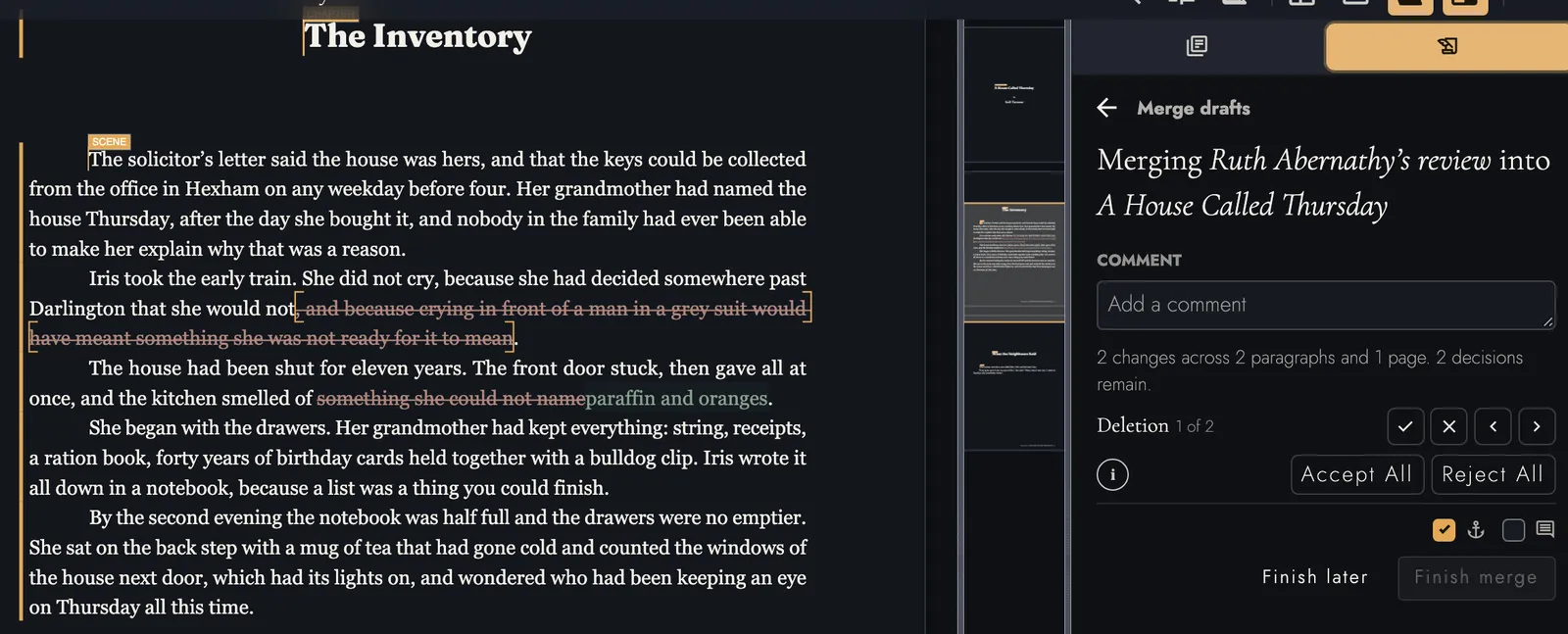
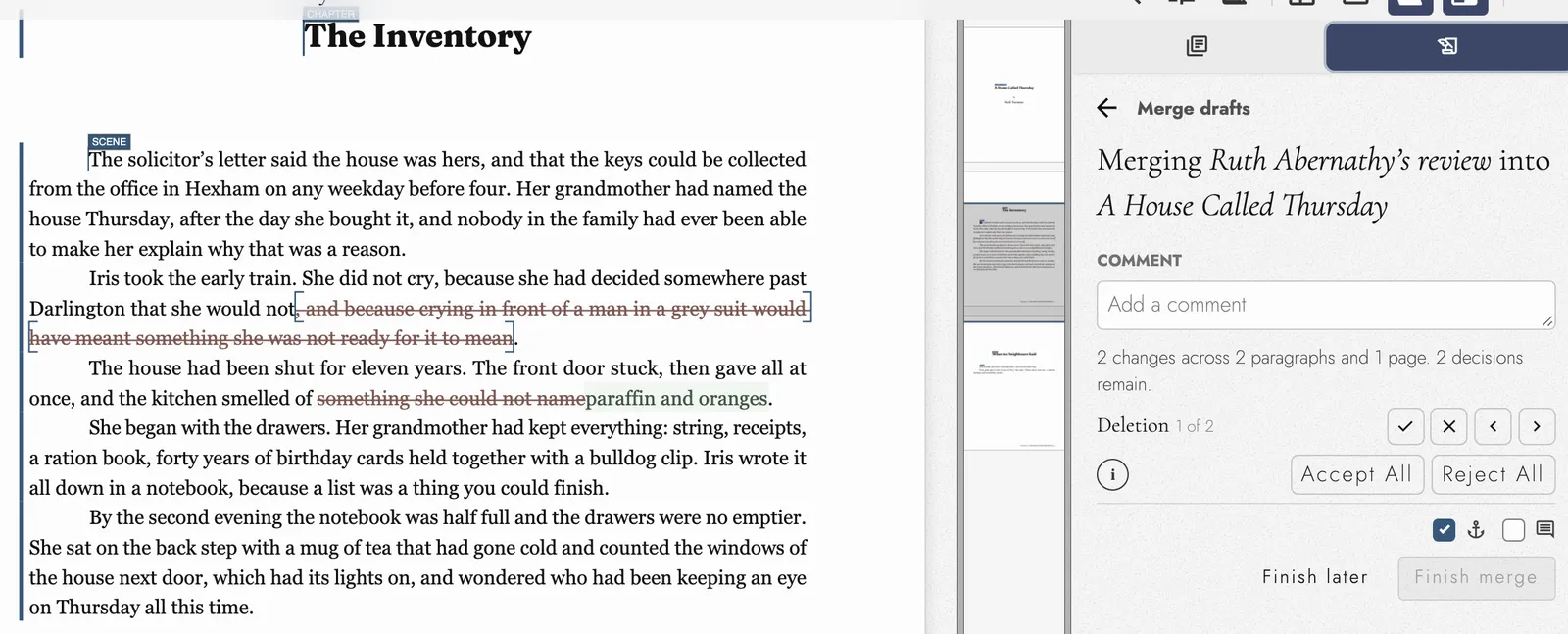
The submission copy belongs to Larkhaven.
When Nell signs off, she exports the finished text once and Ruth brings it into Larkhaven’s team. Now there are two copies with two owners. Nell goes on writing in hers. The agency keeps the one it sends out, and that one stays with Larkhaven even if Ruth someday leaves.
Ruth marks the book confidential. Her colleagues can’t open it until she gives them a reason. Before the first round goes out she takes a snapshot and names it for the round. Months later, when an editor says they read the old ending, she can check.
Take and name a snapshot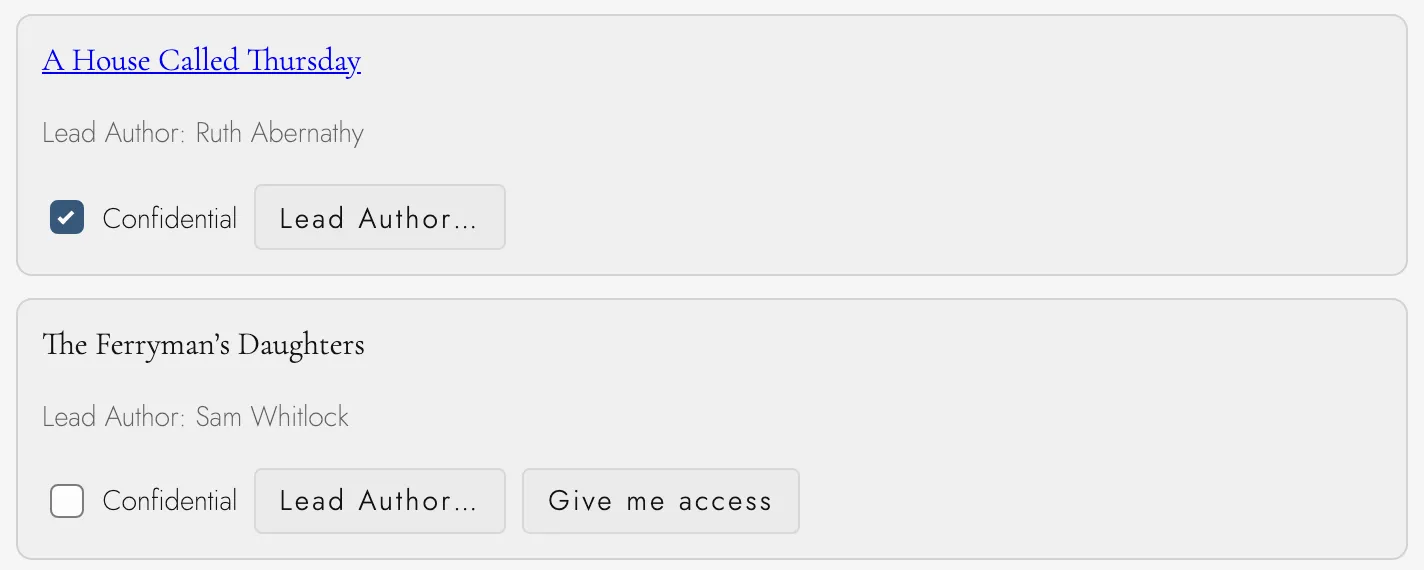
Marisol gets a copy that runs out.
Marisol works at another firm. She wants the book before any deal is done. Ruth invites her to the agency’s copy with access ending on November 20. Copying is held to three paragraphs in a row, and export is off.
Her invitation now sits on the book’s share list, with the day it went out and the day it ends. An invited editor can’t share the book onward, so Marisol can’t pass it to a producer without coming back to Ruth. If the deal stalls, Ruth revokes it from the same list.
See who has a copy, and end it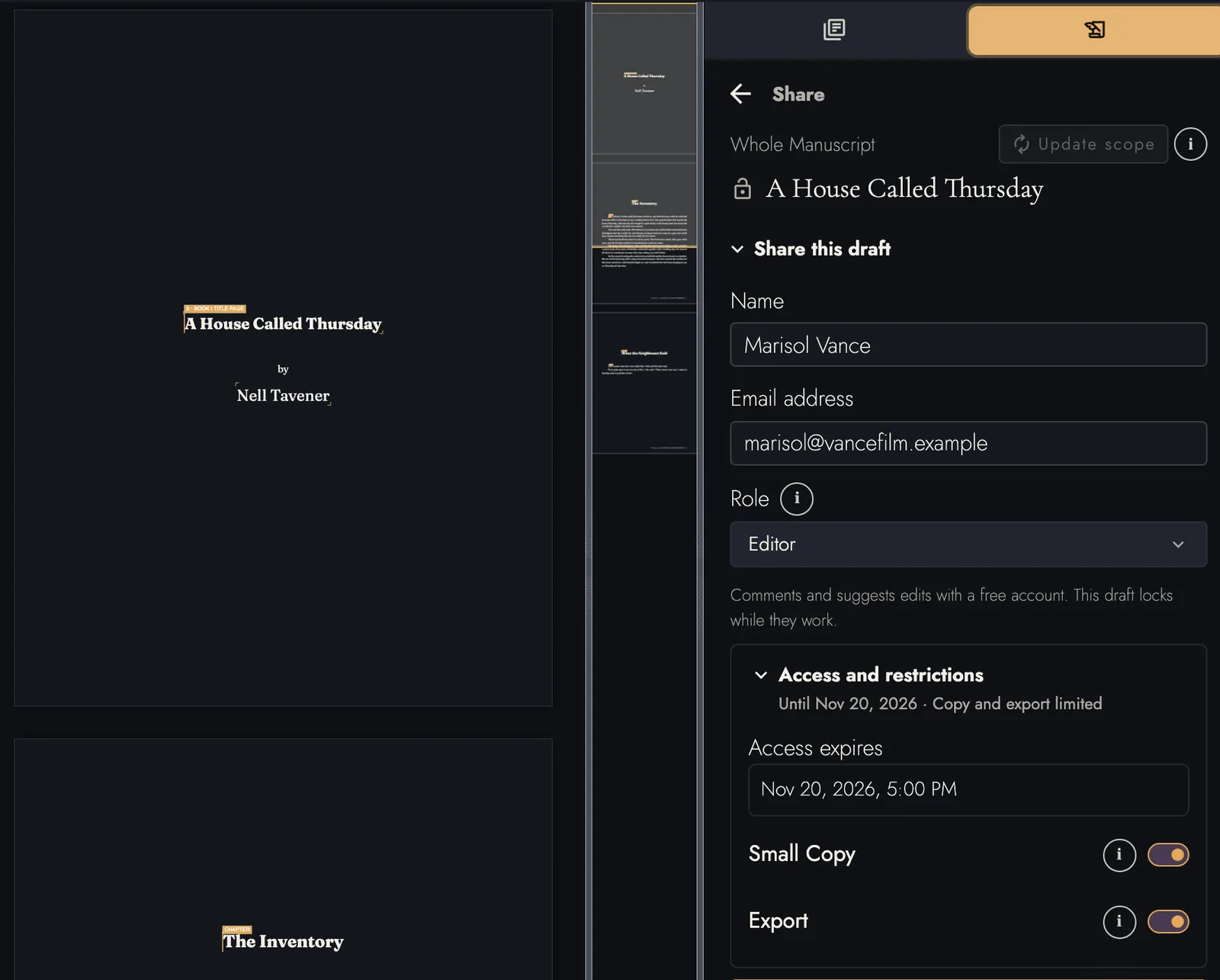
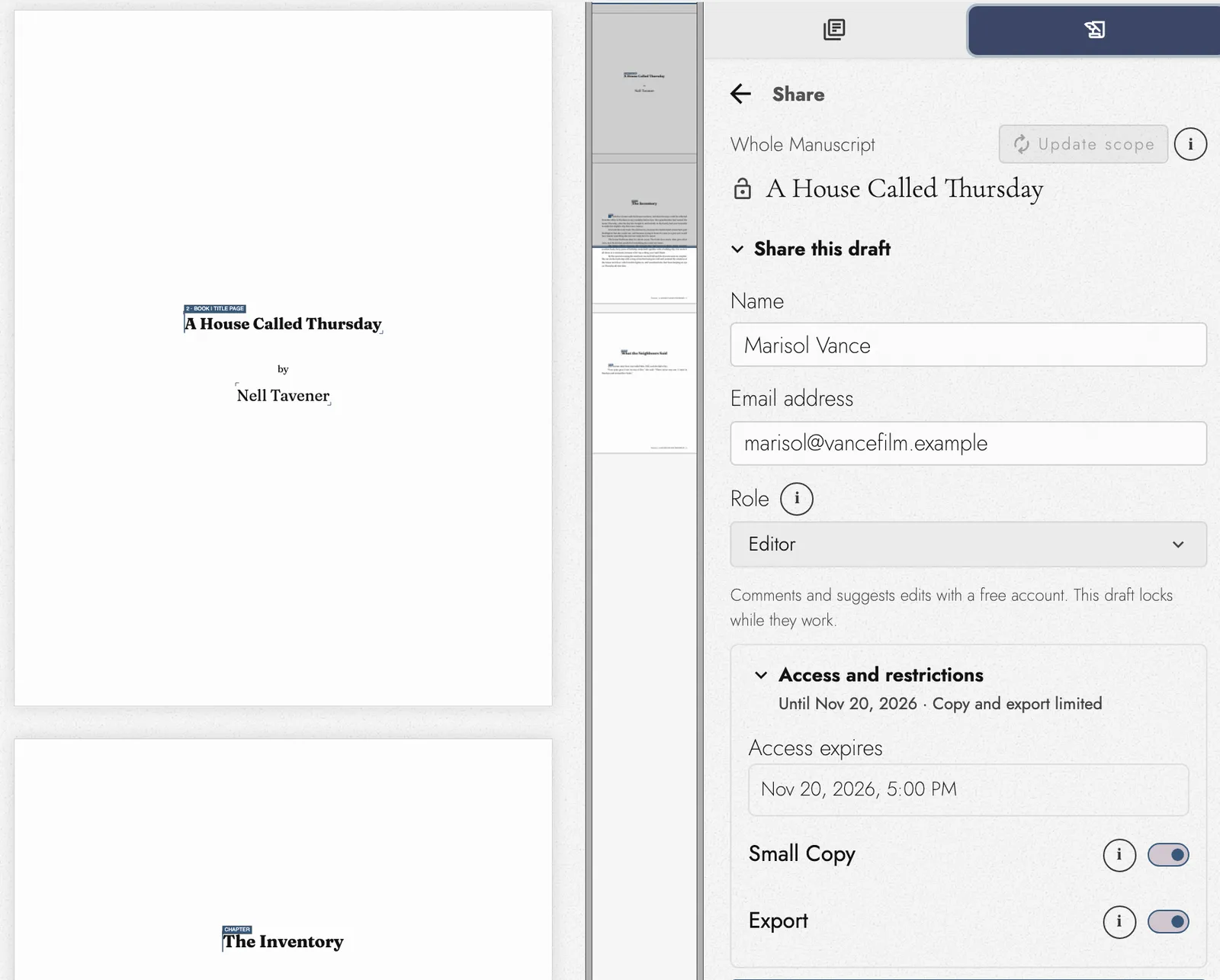
Who has the book, and since when
An agency rarely worries about the editor it chose. The worry is the forward it never sees, like an attachment that lands on a desk three people later, or a manuscript someone pastes into a chatbot to read it faster. A copy sent from the team with export off doesn’t leave as a file at all.
A seat at Larkhaven doesn’t open every book on the list either. Agents reach the books they are given, and the team’s settings say who may send anything out.
- Each invitation has its own end date, and an editor’s access stops on that date whether or not they have finished.
- The team decides who may share and who may export, so a new assistant can’t send a book out by mistake.
- Who was given access to which book, and when, stays in the team’s audit history.
Questions you’ll have
Our clients write in Word. Do they have to switch?
No. Most of a list never will, and nothing here depends on it. Bring a client’s Word or Scrivener file into the agency’s team and do the editorial pass there. A client who already writes in Tabularia can invite you into their own book, which costs the agency nothing. What imports, and how.
Can these limits stop a book from leaking?
They make leaking slow and deliberate, which is about all software can do. With export off and copying capped at three paragraphs, nobody pastes a whole novel anywhere in one go. A screenshot gets past them. So does a phone held up to the screen, or a patient typist, and I’d rather you heard that from me.
We’re a large agency. Is there single sign-on?
Not yet. If your security team needs SAML or SCIM before anyone opens a manuscript, Tabularia isn’t ready for you, and I won’t claim it is. Ask me where it stands.
What about the book-to-screen side?
A screenplay gets its own exact page grid, a minute to the page, and Fountain and Final Draft files go both ways. The adaptation can live in the agency’s team beside the novel it came from, under the same limits.
A pilot first, then seats
I’m Allen, and I built Tabularia. I set up each team by hand. Choose one client’s book that is about to go out on submission and we’ll run it in Tabularia together for 14 days, at no charge, with the people who already work on it.
After the pilot, a seat is $35 a month on a yearly plan or $40 month to month, from 3 seats. Seats are for the people who write and edit. A client, an author, or any other outside reviewer joins as a guest and pays nothing.
If you’d rather recommend Tabularia than buy seats, the Partners program gives the writers you send 20% off their first year and pays you 30% of what they pay for 12 months.
Book a 20-minute walkthrough How team accounts work Every plan and price