Every thread of the novel, in its own lane.
A clue can be clear in one scene and lost across a whole book. Follow Morgan Vale through a revision of The Lantern Coast, a fictional demo series, with the timelines doing the remembering.
Give every thread its own timeline.
The Lantern Coast runs on more than one line at a time. Mara’s investigation is one. The tides that keep disagreeing with the harbor master are another, and Oren’s choices are a third.
Morgan makes a timeline for each and names it after the thread. In the timeline drawer they run as lanes under the outline, every marker standing where a scene does that thread’s work. A long empty stretch in one lane is a thread the reader has stopped hearing about.
Timelines in the Guide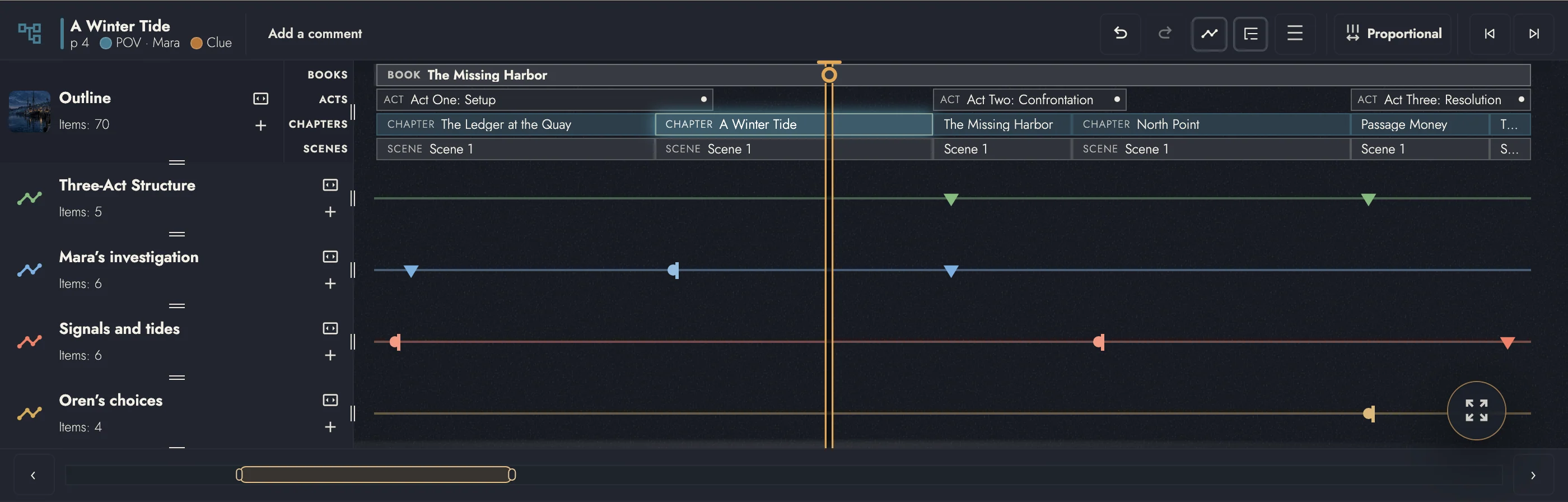
Give the clue a place in the story.
Mara sees the harbor master close a ledger. Morgan wants that moment to stay small, but not to disappear among the later discoveries.
An anchor on the investigation timeline holds the passage and a note about what Mara notices. Rewrite the sentence and the anchor goes with it.
Place anchors
Read the investigation on its own.
The clues cross several books. Reading every scene in between would make it hard to judge their pace.
Pin the timeline. Its anchored passages become the reading for this pass, with the hidden stretches folded down to a line that says how much was skipped. Morgan can follow the investigation from the first ledger to the last letter, then unpin it and have the whole book back.
Pin a timeline
Hold the plot against a structure.
Morgan wants to know whether the midpoint lands where a mystery reader expects one. A story structure answers that without rearranging anything.
Added to a written book, a structure such as Three-Act or Cozy Mystery puts its beats on a timeline of their own. Each beat carries a note about the work it does, and Morgan drags it to the scene that actually does that work. When the structure has served its purpose, dissolving its timeline removes the beats and leaves the prose exactly as it was.
Story shapes in the Guide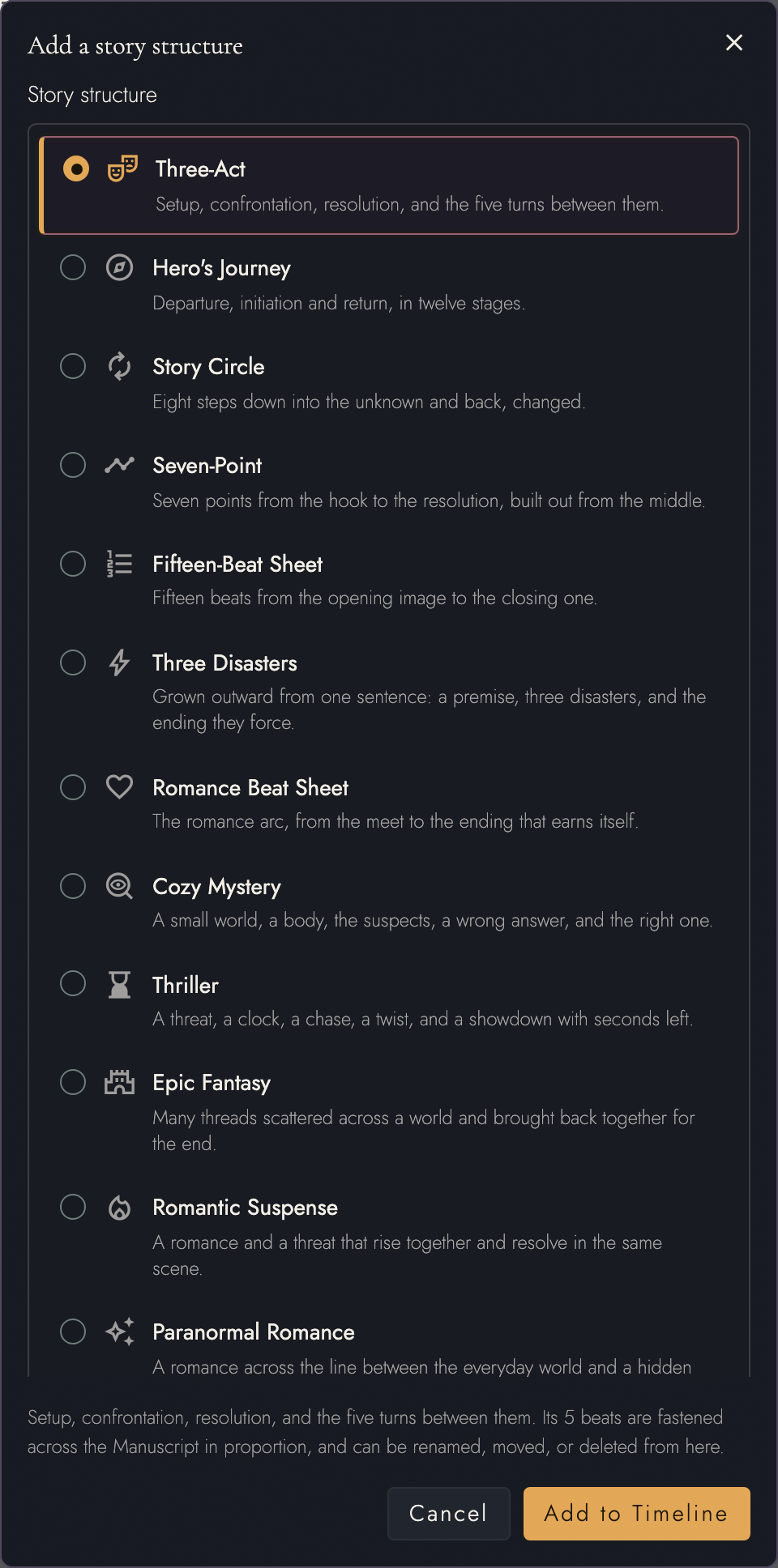
Keep the whole cast within reach.
Theo watches the tides and trusts Mara more than he should. Oren captains the packet boat and saw more than he says. Their Sheets sit in the right panel, so a fact about either one is a click away from the scene that needs it.
Places and items get Sheets too. Search the library by name or nickname.
The Sheets library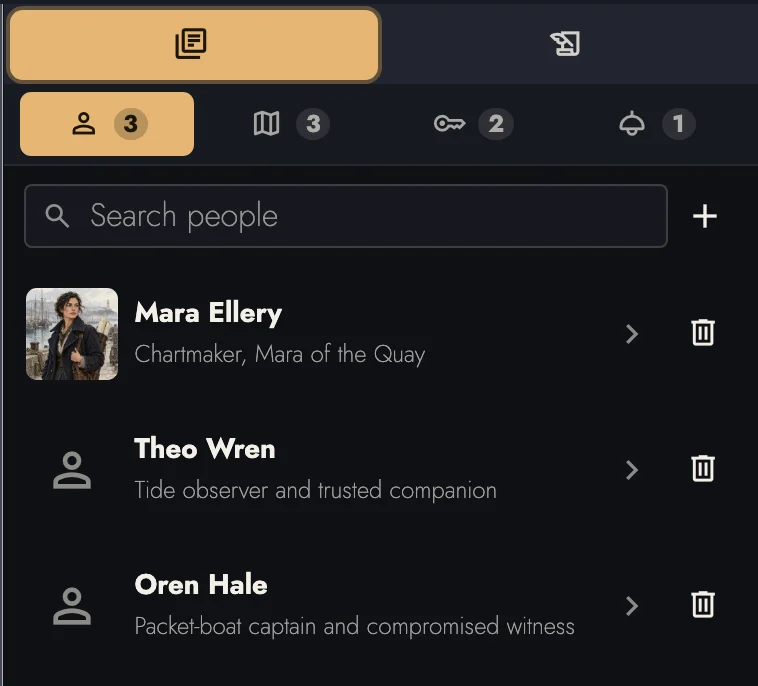
See exactly what the new opening changes.
A quieter first scene might let the ledger do more work. Morgan keeps that experiment in a draft instead of committing the book to it.
Markup lays the two readings over each other on the page: the words the new opening drops are struck through, and the ones it adds are marked in color. Merge it a difference at a time, or keep both and decide next week.
Markup in the Guide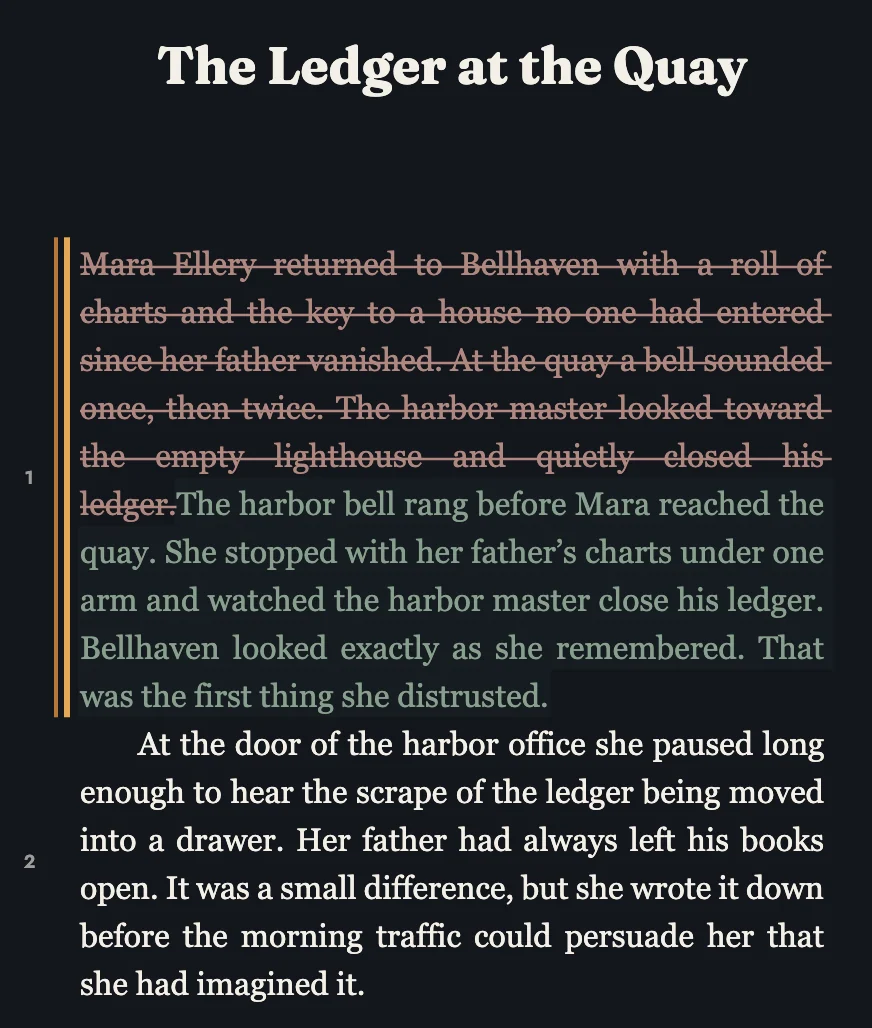
Decide how each chapter opens.
The Missing Harbor starts every chapter on a new page with its title set large and a drop cap on the first paragraph. The preview shows the result on sample text before any of it touches the book.
Prologues and epilogues can have a design of their own, and so can every other book in the series.
Chapter openings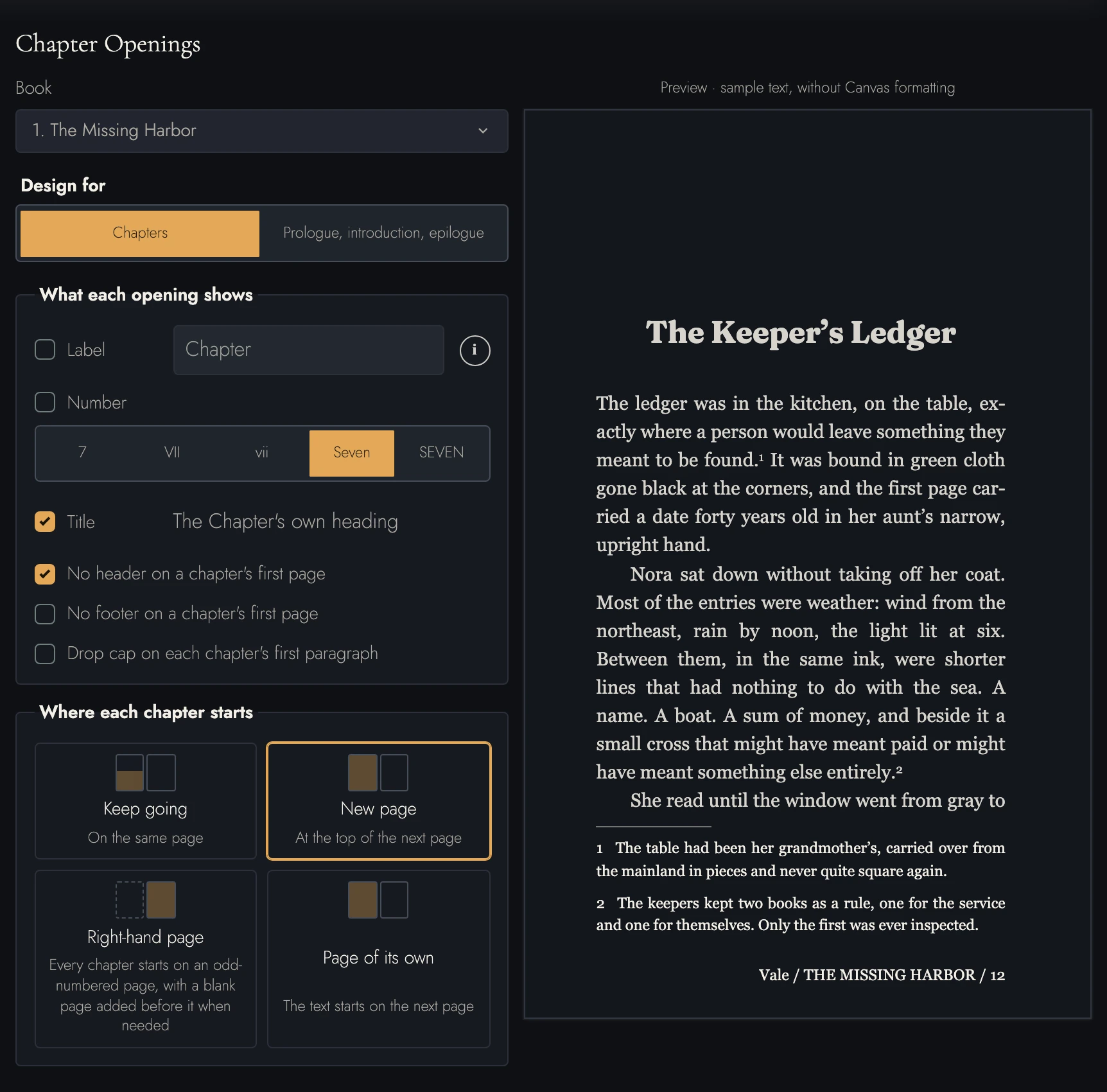
Bring your own work to the page.
Start a project or import a manuscript you already have. The Guide is there when you need the steps for a particular task.
Take another tour.
- Overview → One revision of a novel series, from draft to reading edition.
- Nonfiction → An argument built chapter by chapter, with its sources kept attached.
- Screenplays → An imported short, a dialogue pass, and a script ready for the next app.
- Articles → An essay from the article starter to a second try at its lede.
- Series → Several books in one manuscript, each with its own matter.
- Editors → A review from the Editor’s side, then back to the author.
- Switching apps → Bringing a Scrivener project across, structure and all.