Lester Dent's pulp formula template
Lester Dent's pulp formula plans a 6,000-word story in four quarters of about 1,500 words. The hero starts in trouble, every quarter ends on a twist, the third brings hard-won progress, and the fourth gets the hero out by their own skill, then ends at once.
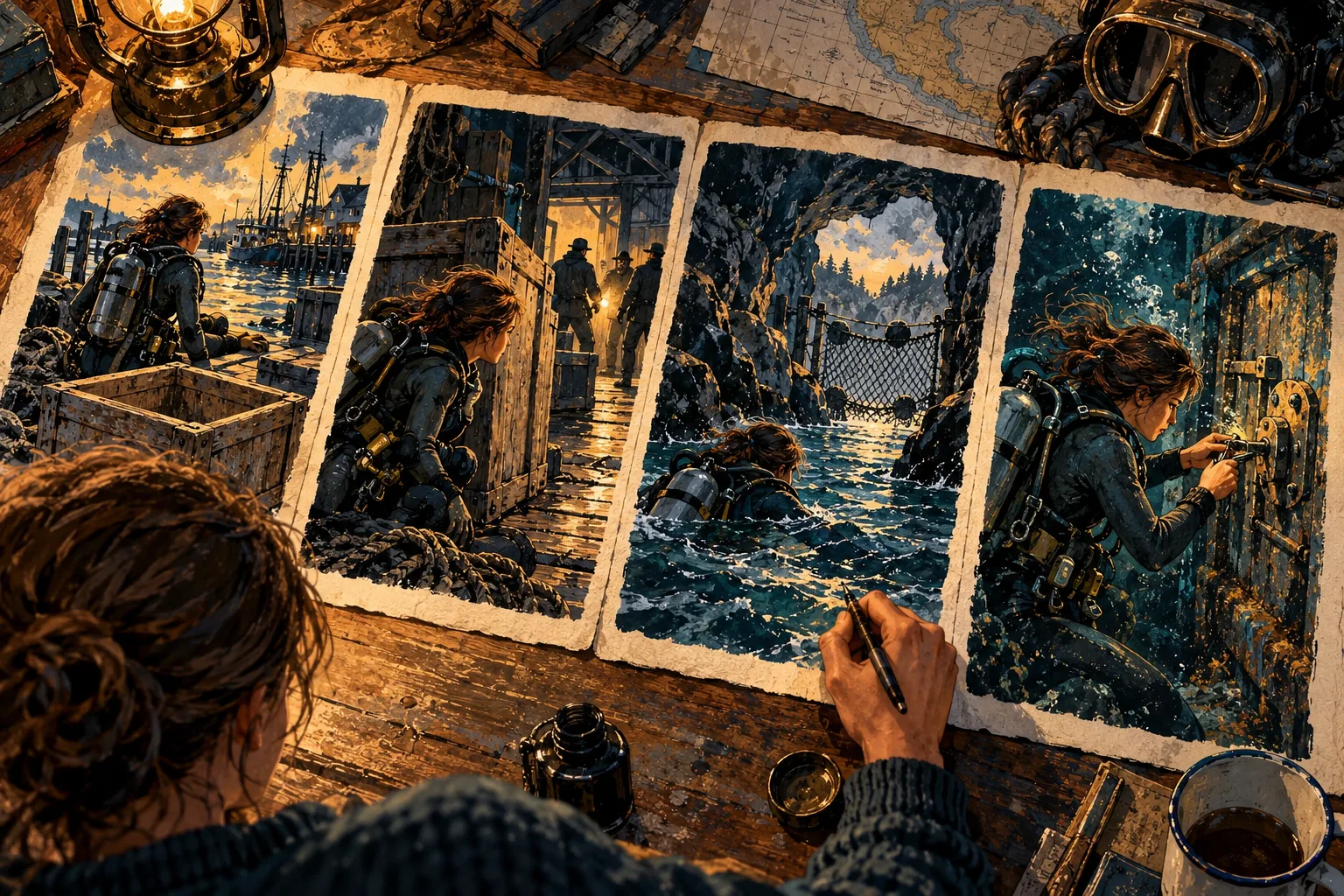
When to use it
- You write short adventure, crime, or action fiction and want it to move.
- Your stories open slowly. The first line here has to put the hero in a fix.
- You want a plan you can hold in your head for a story finished in a weekend.
Lester Dent, who wrote most of the Doc Savage novels, published the formula in a 1936 writers' annual. We describe what it asks of a writer in our own words rather than quoting it.
The 4 acts
- Part One: Trouble. Before the first line, choose one unusual danger, one unusual prize, one unusual setting, and a menace over the hero. Then straight into trouble, and end the quarter on a twist.
- Part Two: Worse. The hero fights back and it goes worse. End on a second twist.
- Part Three: Headway. Real progress, paid for, and the deepest trap yet.
- Part Four: The Way Out. Out by their own skill, a last surprise, and a fast finish.
The 10 beats at 6,000 words
The marks assume 6,000 words, because the formula was built for a 6,000-word story. Each beat keeps its percentage at any length, so scale the marks to your own. The story structure calculator works them out for any length.
- Open in Trouble 3% · word 200 The opening line puts the hero in a fix. No warm-up and no weather.
- Everyone on Stage 10% · word 600 Bring on the whole cast in the first quarter, each doing something that matters later.
- First Twist 22% · word 1,300 End the first quarter on a complication that changes the problem.
- Pile It On 32% · word 1,900 The hero pushes back and it goes badly: a fight, a trap, a setback they can feel.
- Second Twist 47% · word 2,800 End the second quarter on a turn that makes everything worse.
- Headway 57% · word 3,400 The hero gets somewhere at last, and it costs them.
- The Deepest Trap 72% · word 4,300 A third twist, and the worst trap yet.
- Their Own Way Out 82% · word 4,900 They get out through their own wit or ability. Never luck, never rescue.
- The Last Surprise 93% · word 5,600 The villain unmasked, or the prize not what it seemed.
- The Last Line 99% · word 5,950 A short turn or a line that lands, and then stop.
A worked example
A salvage diver in a fog-bound harbor town finds a crate that three divers have already died trying to raise.
- Open in Trouble. Her air line is cut forty feet down, and she has to cut the crate loose to surface.
- Everyone on Stage. The harbormaster, the diver's brother, a buyer in a white suit, and the widow of the last diver.
- First Twist. The crate is empty, and the buyer pays her anyway.
- Pile It On. Her boat is sunk at its mooring and her brother is arrested for it.
- Second Twist. The harbormaster owns the white-suited buyer's debts.
- Headway. She finds where the crate's contents went: a wreck charted nowhere.
- The Deepest Trap. The harbormaster floods the wreck's hold while she is inside it.
- Their Own Way Out. She breathes from the air pocket of an upturned lifeboat she spotted on the way in.
- The Last Surprise. The widow was the buyer's partner all along.
- The Last Line. She hands the widow the harbormaster's ledger and says she'll take her fee in cash.
Open this template in Tabularia
Tabularia opens a new Book on the Pulp Formula shape: its acts and a chapter for each beat, named for it, with each note pinned beside the chapter it belongs to. The book's word goal is set to 6,000 words. You name the Book before anything is created.
Or take it away
The Word file has every beat with its note and mark, a line under each for your own plan, and the example above. It opens in Word, Google Docs, Pages, and LibreOffice.
Related templates
- Three-act structure template — Setup, confrontation, and resolution, with the five turns that hold them together.
- Thriller beat sheet template — A threat, a clock, a chase, a twist, and a showdown with seconds left.
- Kishōtenketsu template — Four movements, with a twist in place of a conflict.